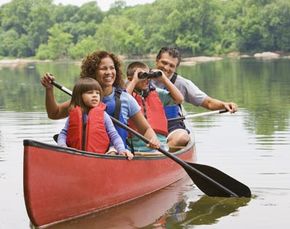
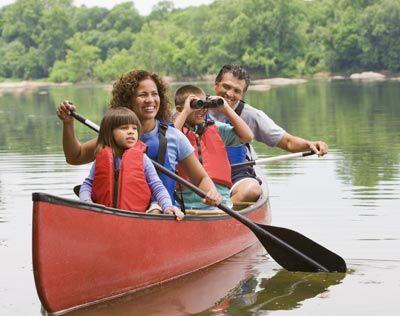
The thrills and excitement of canoeing attract people of all ages, like this family.
Ariel Skelly/Blend Images/Getty Images
Imagine the feeling of excitement as your canoe slices through the water in time with your paddle strokes. You float on a placid lake, and your mind and body are in tune with the wind blowing through the trees -- no motor to interfere with the sound of the flowing river. Canoe lovers return again and again to retreat into nature and escape the hustle of modern life. It's therapeutic and calming, and it also provides a strenuous and rewarding workout.
Canoeing is simply propelling a canoe with a paddle using only human muscle power. It's popular throughout the world for recreation and sport, although it's still used in some places for transportation. You can find canoe clubs and retail stores in just about every city where there's a river, lake or sea. Canoeing is also an official Olympic sporting event that draws both male and female athletes. It's even opening up new worlds of opportunity to the physically challenged.
Advertisement
There are many types of canoes -- dugout canoes, outrigger canoes, whitewater canoes and kayaks among others. Canoeing refers to both the canoe and the kayak in many places throughout the world, but canoeing refers just to the canoe in the United States. In this article, we'll focus on the open canoe.
With so many people drawn to canoeing, it seems like canoes are a lot like cars -- different strokes for different folks. So, let's find out what's up with the types of canoes people use.
X-Canoeing
Although canoeing might seem like the ultimate calming and peaceful activity, it's also evolved into a high-paced, exhilarating extreme sport. Whitewater canoeing and kayaking are very popular in Europe. Canoeists and kayakers navigate through raging rivers or embark on extreme expeditions to faraway locations, carrying all of their equipment in their canoe.
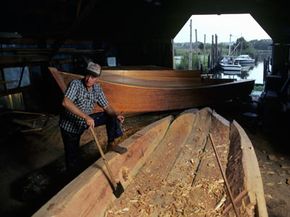
Wooden canoes like this hand-carved one are just one of many types of canoes on the market. Can you find the hull?
Karen Kasmauski/Science Faction/Getty Images
Today's canoes come in a vast assortment of materials, shapes, sizes and colors, but they all have the same purpose -- to keep you out of the water. So, what makes a canoe float, anyway? The laws of density, explain why a canoe floats. Buoyancy tells us that the weight of the water displaced by the canoe must be equal to the weight of the canoe for it to float. This ties in to density -- if you drop an object into a liquid that's less dense than the object, the object will float. A canoe's shape, like the shape of a cruise ship or even a fishing boat, is purposely designed to make it float.
Most canoes are made of wood, aluminum or fiberglass. Would you believe there are even folding and inflatable canoes? These are usually made of PVC, hypalon and other man-made materials.
Advertisement
Typically, canoes are between 11 to 30 feet long. Smaller canoes are usually 11 to 15 feet. They're typically used by single paddlers and children. On the other hand, larger canoes are usually from 16 to 18 feet are used as guide boats and are popular with both solo and tandem paddlers. Most of the time, canoes used for recreation can carry from one and four people. The largest canoes are used for carrying freight and commercial fishing.
In general, a well-designed canoe has a long lift to the canoe. A canoe with a rockered (slightly curved) bottom can go faster and is easier to paddle because its shape reduces friction. If you're looking for the most stable canoe, find one with a flat, wide bottom.
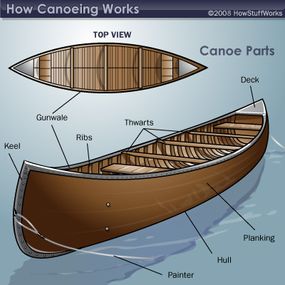
Here are the main parts of a canoe that you should know:
Gunwale: top edge extending around the canoe from bow to stern
Beam: point of greatest width
Bow: front of the canoe
Deck: wood pieces fitted between gunwales at the extreme ends of the canoe
Freeboard: portion of the hull between the gunwales and waterline
Hull: body of canoe
Keel: outer strip on bottom of canoe in the center extending from bow to stern
Painter: rope attached to bow and stern
Planking: flat sections of wood forming the hull fitted lengthwise
Ribs: curved pieces of wood on planking running crosswise
Thwart: crosswise supports between gunwales which help canoe maintain shape
To get the most enjoyment out of your canoe, select one that matches your skill level and purpose. If you're a first-time canoeist, you may be interested in an aluminum canoe, since it's heaviest and comes with buoyancy chambers that help keep it afloat.
By the way, what does all this fun cost? If you're buying a brand-new canoe, expect to pay between $300-$1,000. Aluminum and aluminum alloy cost $300-$600, while fiberglass canoes range from $500-$900. Their wooden counterparts are at the higher end, commanding $750-$1,000.
Now we've got a good idea of what types of canoes are out there and how they're used, let's see what else we'll need -- the gear.
Brush Up on Your Canoe Lingo
Aft: towards the stern
Amidships: at the middle
Broadside: movement in a sideward direction
Forwards: toward the bow
Leeward: direction away from wind
Pivot: movement of canoe with each end of the canoe moving in the opposite direction
Port: left side of canoe
Starboard: right side of canoe
Rhythm: bow and stern paddling in unison
Solo: one paddler in center of canoe
Stern: back of canoe
Tandem: two paddlers- one at bow and one at stern
Wake: action of water as a result of movement of canoe
Winward: direction from which the wind in blowing
Advertisement
Canoeing Gear and Accessories
One of the most important things you'll need to canoe is a life preserver. You should always wear it while you're canoeing. It's not a substitute for strong swimming skills, which we'll talk about later, but it's definitely necessary just in case you capsize. But, that won't happen, right?
Next, you'll need paddles. The average canoeist paddles 25 strokes per minute. That adds up to 1,500 strokes per hour [source: Malo]. So, make sure you select a paddle that's the appropriate weight for your skill level. You have hundreds of combinations of paddles to choose from, since they have different blades, grip shapes and lengths. Also, they can be made of spruce, fir, cedar, basswood, ash, cherry or maple. Spruce paddles are popular because they're light and easy to handle. Generally, for a beginner paddler, a light paddle works best.
Advertisement
A good way to choose the right size paddle is to stand it vertically in front of you. The one that meets your eye level is your size. If paddling in tandem (two people), the bowman's paddle should reach from the toes to the chin, while sternman's paddle should reach from the toes to the forehead. We'll talk more about bowmen and sternmen later. A longer paddle gives you more leverage which makes it easier to handle. Solo paddlers, in particular, find longer paddles really helpful.
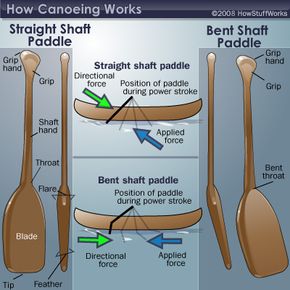
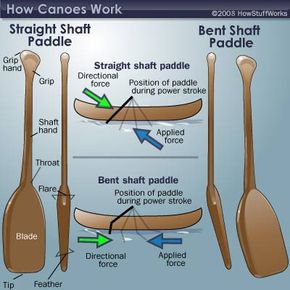
Here are some helpful terms to know when selecting a paddle:
Blade: large flat portion of paddle
Grip: handle of paddle
Grip hand: upper hand located on grip of paddle
Feather: flat position of blade in recovery to cut down on wind and water resistance
Flare: area of increasing width of paddle where shaft joins blade
Shaft hand: lower hand located on the shaft of the paddle
Throat: junction of shaft with blade above the flare
Tip: end of the blade
You may also want to pick up a few more canoe accessories like poles to navigate shallow streams, canoe seats and rubber mats.
Get ready for some action because next we'll learn how to carry, launch and navigate a canoe.
Take Care of Your Paddle and Canoe
With proper maintenance, paddles and canoes can last a lifetime. It's a good idea to rub new, unpainted wooden paddles with linseed oil. Apply several coats -- until the wood can no longer absorb oil. Then, apply a coat of spar varnish. Sandpaper the entire paddle surface with fine-grain sandpaper and varnish again.
You'll find aluminum and fiberglass canoes easier to maintain than a wooden one. Be sure to wash off wooden canoes before you haul them ashore. Store your canoe in a dry place, like a garage or basement. If you have to keep your canoe outside, it's a good idea to construct racks to keep it off the ground.
Advertisement
Get Ready to Launch Your Canoe
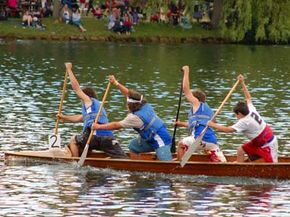
Using what they've learned about canoeing, these canoeists race to the finish line.
First of all, you need strong swimming skills to safely operate a canoe. Although it's no substitute for the ability to swim comfortably in deep waters, always wear a life preserver. It can mean the difference between life and death in the event your canoe capsizes.
Before you take your canoe out into water, you should practice paddling strokes (which we'll learn more about later) at the side of a dock or swimming pool by kneeling and paddling in the water. This will allow you to focus on strokes rather than the canoe, balance or other issues. Next, you can paddle in tandem with another person. Finally, you should practice paddling on both sides of the canoe so that you can not only become a stronger paddler but also become able to adapt to many different paddling positions.
Advertisement
Depending on the distance from your vehicle to the water, the canoe can be carried in a variety of ways. The most common method to carry a canoe is to have the paddlers on opposite sides at each end of the canoe, supporting the bow and stern.
When you are ready to launch the canoe, the bowman and sternman should position themselves at either end of the canoe and gently lower the canoe on its keel. Then, move to the center of the canoe on opposite sides so that you are facing each other. Spread your hands a distance apart, grip the gunwales, bend your knees, and lift the canoe. If launching at a dock, pace the bow or stern of a canoe in the water so that it slides in the water at a slight angle. Crossing hand over hand, gently ease the canoe into the water.
Has anyone ever told you to never stand up in a canoe? That's one of the most important things you need to know. When entering a canoe, the remember is to keep your weight centered and low. This gives you the most stability. If you're loading at a dock, turn the canoe so that it's parallel to the dock. Before you get in, put the rest of your equipment in the canoe. Your paddle(s) should be stowed on the far side of the canoe with the blades under the bow and stern decks. Next, have your partner steady the canoe while you step into the center. Grasp both gunwales for support. After you're in a kneeling position in the bow or stern, steady the canoe so your partner can step in and sit down. If you're canoeing by yourself just approach your canoe in the middle, grab both gunwales for support and lift your body over the side and into the canoe.
If you're loading from a beach, slide the canoe as far into the water as possible. Next, your bow paddler should step directly over the keel in order to avoid placing extra weight on the hull. He or she will grasp the gunwales and slowly walk forward. As the sternman, you'll push the canoe into the water, wade out slightly, push off with the rear foot, and step into the canoe. Again, if you're canoeing solo, once you wade out in the water with your canoe, get to the middle of the canoe, grab both gunwales and lift your body into the canoe.
While canoeing is both physically and mentally rewarding, it can also be dangerous under certain conditions and if proper safety precautions are not taken. If you capsize, hold onto your canoe! No matter what happens, stay with your craft. It's also a life preserver and will support you indefinitely. Never leave your canoe to swim to shore.
To get back into your canoe, go to the middle, because this part offers the most stability. Hold onto the closest gunwale and kick your legs up to a horizontal position in the water. Then, press down on the near gunwale and reach for the far one. Keep your elbow up, and kick yourself across the canoe. Roll and let your hips drop inside. Start paddling again. If you lose your paddle, kneel down and use your hand to paddle.
We've learned the basics of canoeing safety, so let's get moving! Discover just how important the paddle is and learn all about paddling strokes on the next page.
The Canoe in Early American Pop Culture
Because the canoe played such an important part in the settling of the North American continent, the vessel also was frequently referenced in songs, poems and paintings. In particular, Henry Wadsworth Longfellow emphasized the importance of the canoe to Native American culture in the closing of his American epic poem "The Song of Hiawatha." As the poem ends, Hiawatha accepts Christian missionaries and launches his birch bark canoe into the Western sunset to depart forever.
Advertisement
Paddling Strokes
Did you realize that, except for the wind, all the energy used to move your canoe through the water is transmitted through your paddle? [source: Newton's third law of motion.
The most basic canoeing strokes can serve a beginner canoeist very well. These versatile, simple strokes can be built on when a canoeist becomes more advanced. Let's take a look at some of the most common strokes. All of these use one hand as the shaft hand and one as the grip hand. As you learned previously, the shaft hand is the upper hand and the grip hand is the lower.
Advertisement
To move your canoe forward, use the force.
Use the backwater to move your canoe backwards. Extend your paddle straight back with your fingers facing down. Insert the blade in the water and push forward.
Sometimes you'll just want to keep your canoe still. Use the hold stroke to prevent headway. One way to stop your canoe is to stroke in the direct opposition to the stroke you were doing -- the opposite of the straightaway. Another way to do this is to paddle horizontally across the canoe. Push your grip hand straight up across your body while pulling the shaft against the canoe with your lower hand.
When you want to change the direction of the canoe, use the draw. You can pivot or broadside your canoe using this stroke. To move the canoe in the direction of your paddling side, maintain the position of your hands on the paddle. Lower the grip hand with your fingers up, and extend the blade out in line with your hip, with the flat portion of the blade facing the canoe. Put the blade into the water. Then, as you push your grip hand across your body towards the water, pull the lower portion of the paddle toward the canoe with the shaft hand so you get an equal push-pull action.
The opposite of the draw is the pushstroke which pushes the canoe away from the paddling side. Insert the blade straight down and slightly under the canoe so that the flat part faces the side of the canoe. The grip hand should be out over the water as if you were trying to pry the canoe loose with the paddle. Push with the shaft hand, and pull down with the grip hand using equal pressure.
To keep a straight course and offset sideward motion from wind or the stern paddler's strokes, use the j-stroke. Start this stroke like you start the straightaway. As the paddle reaches the area of your hips, start turning the blade away from the canoe by turning the grip in a clockwise direction. Apply continual pressure against the water by pushing with the shaft hand, and pull with the grip hand. As you finish, the blade should be in a position with the flat portion parallel to the side of the canoe.
If you're the sternman, another stroke you'll use is the sweep stroke. Do this to turn the bow from your stern's paddling side without affecting speed. With the grip hand at waist level and the flat portion of the blade facing forward, extend your paddle to the side in line with your hip and horizontally sweep back toward the stern. Pull with the bottom hand and push horizontally with your grip hand to get leverage.
Depending on the direction you wish to turn your canoe, here are a few ways to turn your canoe:
Both paddlers draw.
Bow does a reverse sweep; stern a forward sweep
Bow does backwater; stern a straightaway
Both do pushaway
Bow does forward sweep; stern a reverse sweep
Bow does straightaway; stern a back water
By now, you can probably paddle with your eyes closed. What's next? Here comes the fun part -- let's explore popular canoeing destinations.
Physics of Canoeing
If you're planning a canoeing trip, it's really helpful to have a basic knowledge of the physics of canoeing. The principles of speed, force, and motion directly apply to the way in which the paddle and canoe interacts with the water. For example, the greater the force of your paddle stroke, the faster your canoe will move. The greater weight, whether it's the weight of the passengers, the canoe or the freight, the more force, or paddling, required. Also working against your partner, or unbalanced forces, will cause the canoe to go in a third direction. This can be an advantage that can allow for steering or a disadvantage that will cause difficulty in controlling the canoe.
Advertisement
Popular Canoeing Destinations
Okay, you've got all the right stuff -- the gear, the lingo, etc. Now decide where to take your canoe. Here are just a few of the many popular canoeing destinations throughout the world:
Patagonia, Chile
Trollfjorden, Norway
Phang Nga Bay, Thailand
Bowron Lakes Provincial Park, British Columbia, Canada
Northern Forest Canoe Trail, New York, Vermont, New Hampshire, Maine and Quebec
Ohio River Water Trail, Markland Pool Section, Ohio and Kentucky
Potomac River Water Trail, West Virginia, Maryland and Virginia
Willamette River Water Trail, Oregon
How did we get a hobby and a sport from something that began as just basic transportation? Let's learn about how the history of Indian canoes shaped the development of the modern canoe.
Advertisement
Respect is Earned
To earn a canoeing badge, a Boy Scout must demonstrate swimming and CPR skills. In addition, he must name the parts of a canoe and paddle, discuss canoe maintenance and explain kneeling and paddling positions. On top of that, a scout must load, carry and launch a canoe and demonstrate basic canoe strokes. One more thing -- he has to rescue a swamped canoe [source: Boy Scouts of America].
History of Canoes
No one can say exactly where canoeing started, but canoes have been around for thousands of years. Several years ago, archeologists discovered the remains of a dugout canoe among ancient ruins believed to be 8,000 years old [source: Antiquity].
Although canoeing is now considered a sport, canoes were used for transportation throughout history. Clues from the history of Indian canoes can help us understand how got the canoes we use today. In North America, the very first canoes were used by the indigenous people of the Caribbean to travel between the islands [source: All About Canoes].
Advertisement
Throughout history -- even over the last century -- the canoe has evolved from those made of logs to modern canoes, made of birch back canoe, was used by Native Americans, explorers, missionaries and trappers. Since it could haul huge lots of cargo while handle all sorts of conditions such as quiet waters, open lakes, quickly-moving rivers and coastal waters, it was perfect to navigate North American waterways.
As soon as European explorers came to North America, they found canoes quite handy and started using them. In fact, the Europeans were amazed with the advanced engineering skills that the Native Americans used to design sophisticated canoes. Instead of hollowed out logs, these canoes were framed and constructed of multiple types of wood and held together with glue made from trees [source: Canoe.ca]. In 1603, Samuel de Champlain was the first explorer to record the dimensions of Native American canoes. He wrote that they measured up to 23 feet (7 meter), to a 50 inch (1.27 meter) beam, and carried as much as 1,000 pounds (454 kilograms) of cargo [source: Malo]. The French used the canoe to establish the fur trade and further explore what we now call Canada and the mainland United States.
Canoeing has deep roots in world history and continues to draw enthusiasts from all walks of life.
What's In A Name?
There are two theories for the derivation of the term "canoe." Some claim that the word is of Arawakan origin. Originally spelled canoa, the word was later Anglicized as "canoe." Another theory posits that the term is derived from the word kenu or kanu which means "dugout" [source:Camp].