Avoiding Shark Attacks
How to Avoid Shark Attacks
It is not very often that a
shark enters a well populated beach area to select a victim from among
a group of people. On the other hand, quite often the victim is the
person suddenly left alone and farther out from shore than others in
the water.
- David H. Baldridge, "Shark Attack"
Every summer, media coverage brings a lot of attention to shark attacks. One result of all this attention is that we tend to perceive the threat as greater than it really is. The same thing happens with airplane crashes. Statistically, driving a car is far deadlier than flying. However, plane crashes are relatively infrequent and horribly catastrophic. They end up all over the news, and the images stay in our minds for a long time. As a result, we tend to overestimate the dangers of flying.
When news stories and scientists do offer real statistics, these are sometimes misleading. For example, it is often reported that you are more likely to be struck by lightning than to be attacked by a shark. This statistic is based on the number of incidents each year. However, anyone can be struck by lightning when there's a storm going through. Your chance of being attacked by a shark is zero if you live in Kansas and don't take a vacation on the coast. If you surf every day off the coast of Florida, the odds of a shark attacking you are much higher.
This isn't to say that anyone who goes into the water should be terrified of sharks, but people who swim and surf in the ocean need to be aware that dangerous wild animals may be present. Educating yourself about the risk factors for shark attacks can help you greatly reduce the chances of becoming a victim.
Here are some general guidelines:
- Don't
swim at dawn or dusk -- sharks are actively feeding at these times.
Visibility in the water is lower, which can lead to mistaken identity
bites.
- Don't swim in murky water -- again, the poor visibility increases the chances of a shark mistaking you for prey.
- Don't
swim with open cuts -- even a small amount of blood in the water can
attract sharks from miles away. Some experts recommend that
menstruating women also avoid swimming in the ocean.
- Avoid
sandbars, sea mounts, and drop-offs -- marine wildlife tends to
congregate at these areas, including many fish that are a shark's
natural prey. The sharks aren't usually far behind.
- Don't
wear contrasting colors -- high-contrast or brightly-colored swimsuits
seem to confuse sharks. Even contrasting tan lines are speculated to
lead to mistaken identity bites.
- Don't wear shiny jewelry -- the sun reflecting off of a watch or necklace can draw a shark's attention.
- Don't
swim when a shark's natural prey is present in large numbers -- if you
are swimming near marine mammals or other shark prey species, and you
see them react with sudden alarm and flee the area, follow their
example.
- Don't thrash around -- smooth,
steady swimming strokes should be used. Frantic paddling and splashing
looks like a wounded fish to a shark. The swimming patterns of dogs can
also draw sharks.
- Don't think you're safe
just because the water is shallow -- shark attacks can occur in less
than three feet of water. While shark activity tends to be greater a
few hundred yards from shore, stay alert even if you're in thigh-deep
water.
- Don't leave shark bait in the water
-- large amounts of bait fish or animal blood will attract hungry
sharks. If you're fishing while standing in the ocean, keep your bait
out of the water until you use it, and don't stay in one place too
long.
- Don't swim when there are sharks in
the water -- this is the most obvious way to avoid sharks. If you know
they're present, stay out of the water.
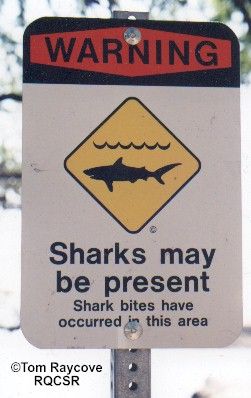
![]() Photo courtesy Tom Raycove, RQCSR |
Deadly Coconuts Whenever there is a series of shark attacks, news stories are invariably accompanied by some statistical comparison that shows some unlikely method of dying is actually more likely than being attacked by a shark. One that has cropped up repeatedly over the years is that more people are killed by falling coconuts every year than by sharks -- usually 150 is the number cited. No reference is ever given for this statistic, and it's actually false. You may not be surprised to find out that no one issues annual reports of coconut deaths. There is no "International Coconut Mortality Journal." In fact, no one really keeps track of coconut deaths at all. A survey of medical literature reveals only a few reports of coconut-related injuries (Best, chapter one). The statistic is an urban legend. |
These tips are not foolproof. There are plenty of instances where sharks attacked in defiance of all shark attack patterns. The best tip is to be alert and always swim, dive, or surf with a buddy. Some attacks can't be prevented, but having someone nearby to call for help can save your life.
If the worst does happen and you find yourself being attacked by a shark, what should you do? If possible, fight back. Despite their ferocity, sharks tend to be wimps. They don't like prey that can cause them harm. Punching, kicking, stabbing and even head-butting are all ways attack victims have fought off sharks. The eyes are particularly sensitive. This kind of response seems to help the shark realize that whatever it just bit isn't its usual prey.
For more information on sharks and related topics, check out the links on the following page.