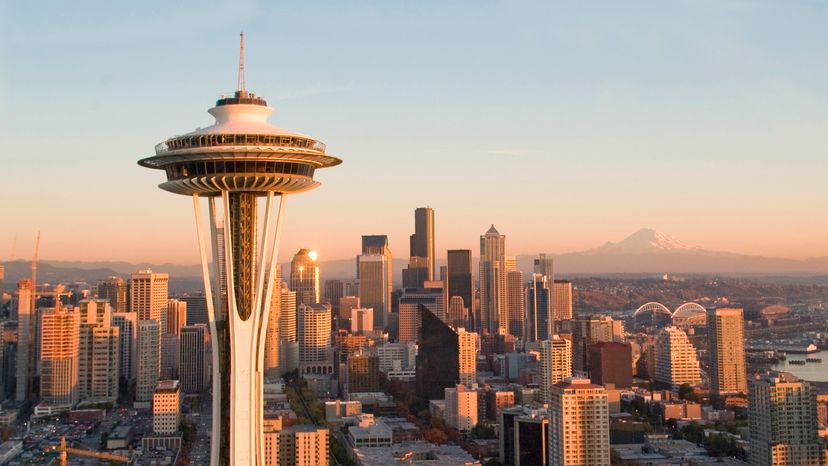
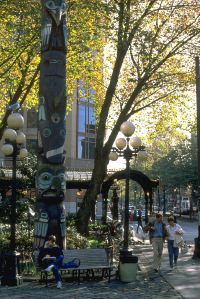
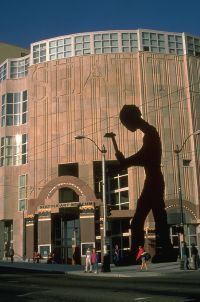
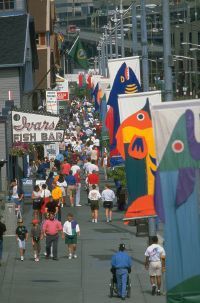
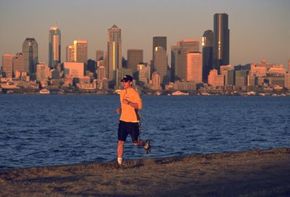
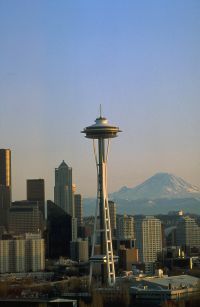
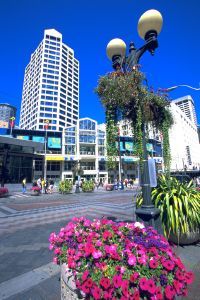
The most northwesterly major city in the United States, Seattle squeezes into a long hourglass shape between Elliott Bay and Lake Washington. Joel Rogers / Getty Images
Say the name "Seattle," and what do you think of? Microsoft, Starbucks, and Boeing. Pike Place Market, the Space Needle, Pearl Jam, and Nirvana. And rain, too.
You're right on all counts, including the rainy climate. But while Seattle skies are indeed gray for much of the year, few cities can compare on the sunny days, which occur more often than you might think.
Advertisement
When the skies are clear, from the window of your downtown hotel room, you can look westward across the harbor, speckled with sailboats and container ships, to the saw-toothed Olympic Mountains. To the north rises the fabled Space Needle; to the south, you'll find majestic and perennially snowcapped Mount Rainier.
In the morning, you can grab a cup of the city's fabled espresso and walk to the rustic Pike Place Market, rising in tiers above the harbor. In the evening, wander up
The Best of Seattle
Why visit Seattle? That depends upon your particular interests, of course, but there's something for everyone. If you're a lover of the great outdoors, there's probably no major city with easier access.
You might spend one day sailing or kayaking between the islets of Puget Sound, another hiking in Cascade Mountain forests, and a third fishing for wild salmon. And if you're here in winter, skiing and snowboarding are less than an hour's drive from the city.
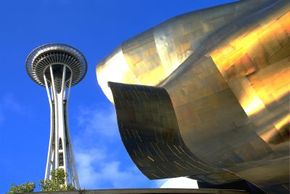
Your interest is culinary? The self-proclaimed coffee capital of the world also has marvelous fresh seafood, distinctive regional cuisine, and the famed Pike Place Market. Industry? Don't miss the Museum of Flight, the Boeing Everett Factory Tour, or the Microsoft Visitor Center. Architecture? The Experience Music Project (EMP), at the foot of the landmark Space Needle, which looks vaguely like a smashed Jimi Hendrix guitar, and the angular new 11-story Seattle Central Library looks every bit as avant-garde as designer Rem Koolhaas's reputation.
And it would be impossible to ignore Seattle's cultural aspects, beginning with its role in contemporary music. The home of Jimi Hendrix and jazz saxophonist Kenny G, among many other Seattle natives, the city has grown to embrace a wide range of modern melody -- from The Kingsmen to Heart, Nirvana to Death Cab for Cutie -- as documented by exhibits at the fine Experience Music Project Museum.
Symphony and theater are similarly alive and well, especially in the Seattle Center. And the top-of-the-line Seattle Art Museum and Asian Art Museum offer collections of world renown.
Fast Facts & Info
Geography and landscape: The most northwesterly major city in the United States, Seattle squeezes into a long hourglass shape between Elliott Bay and Lake Washington. Girdled by a ship canal that connects the two larger bodies of water, it's a community of rolling hills, speckled with small lakes and surrounded by high mountains -- the volcanic Cascade Range to the east, the jagged Olympic Mountains across Puget Sound to the west. Seattle covers only 84 square miles and is a mere three-hour drive from Portland, Oregon, and Vancouver, British Columbia.
General orientation: Most streets in Seattle run either north-south or east-west, except the old town area that is bounded by Elliot Bay on the west,
On north-south streets, odd numbered addresses are on the west side of the road with even on the east. On east-west streets, odd-numbered addresses are on the south side of the road and even numbers on the north side.
Downtown Seattle nestles on the shore of Elliott Bay, spreading down the slopes of steeply rising hills on the west side of Interstate 5. Immediately north of downtown is Seattle Center, the 1962 World's Fair's site crowned by the Space Needle; immediately south are the professional football and baseball stadiums. Heart-shaped Lake Union, the center point of the Lake Washington Ship Canal and site of numerous restaurants and attractions, is located to the northeast of Seattle Center.
The progressive area of Capitol Hill is east of downtown; upscale Queen Anne Hill is north of Seattle Center. On the far side of the ship canal you'll find the University of Washington campus east of Interstate 5; bohemian Fremont and the Scandinavian enclave of Ballard lie to the west. Further north is the charming Green Lake neighborhood; Seattle's south side tends more toward the industrial and has fewer visitor attractions than the north.
Safety: Seattle is generally regarded as among the safest of American cities, but visitors should still take common-sense precautions. You can discourage crime by having a companion, particularly at night, by knowing your whereabouts and route at all times, and by not displaying large amounts of cash or expensive jewelry. Always stay on well-lit, well-traveled streets, and avoid less touristy neighborhoods such as the Central District, Rainier Beach, and Beacon Hill, especially after dark.
Population: Seattle's population is less than 600,000, but more than 3 million Washingtonians reside in the greater metropolitan area, stretching south to Tacoma, north to Everett, and east to the Cascade foothills.
Climate/weather: Seattle has a reputation for rain. It's well-deserved, but more for the number of overcast days than for the actual amount of precipitation that falls here. In fact, many other American cities -- New York, Houston, and Miami, to name three -- receive more rainfall over the course of a year than Seattle's average of 37 inches. Even when it's overcast, the gray skies are offset by breathtaking mountains and lush greenery.
If you don't like damp weather, you'll want to avoid mid-winter, when temperatures normally range in the mid-30s and 40s (Fahrenheit), and instead visit in mid-summer. July and August are the sunniest, driest, and warmest (averaging in the 80s), but anytime between May and mid-October is worth a gamble on the weather. Despite Seattle's northerly latitude, snow is an infrequent occurrence any time of the year.
You can't take advantage of Seattle's many sightseeing opportunities if you don't know how to get around the city. On the next page, we provide vital advice on navigating Seattle.
on the south,
on the north, and Broadway on the east. As a rule, only blocks that run more or less east-west are labeled "street" and those that run north-south are labeled "avenue." However, a road, boulevard, way, or thoroughfare may run in any direction.
to the hip Belltown neighborhood for dining and dancing in clubs where the next great band might be seeking its big break. Life in Seattle is never dull, as you'll discover in this Emerald City of the Pacific Northwest.
Seattle's street system is pretty easy to get the hang of, but you'll want to carry a map just to play it safe. You'll also want to read the following Seattle transportation primer.
Rental car: Most major rental-car agencies serve the Sea-Tac airport. Counters are located in the baggage claim area, with checkout areas on the lower level of the facing parking structure.
Taxi: Several taxi companies service the Sea-Tac airport, waiting for patrons in a designated area outside baggage claims. Rates are set at $2.50 for the meter drop, $2 per mile, and 50 cents for each rider beyond two passengers. If your designation is a downtown Seattle hotel, your fare will be a flat rate of $28.
Luxury town car service with Skyline Transportation (866-664-2227) or Classic TownCar (888-809-3334) costs $32 to $40.
Public transportation: Information desks in the airport's baggage claim area provide full information on all transit options from the airport -- all of them conveniently located nearby.
Most shuttle services operate from 5 am to 11 pm, with return airport trips by reservation. The Shuttle Express (425-981-7000) drops off passengers at hotels and residences. Rates are $28.75 for one or two people, and $4 per each additional passenger. Gray Line's Seattle Downtown Airporter Shuttle (866-235-5247) serves the downtown hotel district only, with rates of just $10.25 for a one-way ride and $17 for roundtrip.
Buses arrive and depart from the baggage claim area near Door 6. Metro Route 194 leaves every 15 to 30 minutes between 6 am and 9:15 pm. Route 174 runs twice hourly, virtually around the clock. The cost is only $2 per ride. For information, contact King County Metro (800-542-7876).
Driving In
Rush hour: Either from the Sea-Tac airport or from neighboring cities, you'll be approaching Seattle on Interstate 5, which runs through the heart of the city from south to north. Coming from the east, chances are you'll approach via Interstate 90. The two major highways join just south of downtown.
The street network is pretty straightforward -- there really are only two other non-freeway arterials, north-south Highway 99 and east-west Highway 520. But Seattle's restrictive geography can lead to severe traffic jams, especially on Interstate 5 north and immediately south of downtown. If you exit the interstate without a street map, you're likely to get lost.
Try to avoid driving on the main roads during rush hours, which are between 7 and 9 am and again between 3 and 7 pm, or earlier on Fridays. If you must drive on Interstate 5 during these hours and want to get through the city as quickly as possible, look for the exits onto express lanes, whose traffic flow
is toward downtown in the morning, away from downtown in the evening. Bear in mind, there are few exits from the express lanes, so they aren't a good option for shorter commutes.
Rules of the road: If you aren't comfortable driving in a rainy climate, now would be a good time to learn. For starters, adjust your speed accordingly. It takes much longer to stop on wet pavement than on dry, so tailgating isn't an option. Keep this in mind, as well, when you're approaching crosswalks -- in general be aware of pedestrians and bike riders.
Public transportation/fares: Take your choice from among buses, trains, streetcars, a monorail, and the most extensive urban ferry system in the Lower 48.
Metro Transit buses are ubiquitous throughout the greater Seattle area, with free downtown service. Fares otherwise are $1.25 and $2. Metro also runs the Waterfront Streetcar trolleys between Pier 70, on the waterfront, and the International District.
Sound Transit links Seattle with neighboring Tacoma and Everett through a network of buses and trains. The Seattle Monorail is a grizzled veteran of 44 years of service along a one-mile route (9 am to 9 pm daily, $2 each way) between downtown's Westlake Center and the Space Needle.
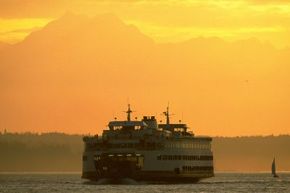
Washington State Ferries cross Puget Sound to Bremerton, Bainbridge, and Vashon islands from Pier 50/52 (passenger fares begin at $6.50), as well as offering four other routes in the greater Seattle area.
Taxis, on foot, or by bike: Taxis are a good option if you're traveling several miles or schlepping luggage, but have your concierge call ahead for you: Cabbies here rarely respond to being hailed on the street. Rates are set at $2.50 for the meter drop, $2 per mile, and 50 cents for each rider beyond two passengers.
In fitness-oriented Seattle, despite numerous steep hills, walking and biking are real options: walking in downtown, biking in the outlying neighborhoods. Many major suburban streets have bike paths distinctly marked on the sides of the roads.
Now that you know where to go, you can begin thinking about exploring. From festivals like Seafair to an underground tour of Pioneer Square, Seattle offers a wide range of special events and attractions to its visitors. See the next section for more information.
Any time of year -- and especially during the drier months of May through October -- you can look to Seattle Center, whose events calendar always seems to be full, or to the city's diverse neighborhoods for celebrations and festivals.
The city's biggest party is Seafair, first held in July 1950 and featuring boat races and a Blue Angels air show, but there's much more. Seattle Center, for instance, hosts the Northwest Folklife Festival in May, Bite of Seattle in July, and Bumbershoot -- one of the country's biggest popular music festivals -- over Labor Day weekend.
Advertisement
If you've got the vacation time, though, you'll want to get out of Seattle entirely for a few days. Take a cruise through the San Juan Islands, venture through the tide pools and rainforests of Olympic National Park, or drive a loop tour through the Cascades, perhaps circling majestic Mount Rainier.
Insider Guide: The Best of Special Events & Attractions in Seattle
Seattle is a waterfront city, but you'll never find the locals on a formal harbor tour. Instead of a tour boat, board a ferry to nearby Bainbridge Island. Wander around the village known for its Victorian architecture and abundant shops and galleries. The island's densely wooded areas and lush greenery attracts outdoor enthusiasts for kayaking, golfing, fishing, and hiking.
Join an underground tour of Pioneer Square (608 First Ave). Modern Seattle was built upon the ruins of the original wood-frame town, burnt to the ground by an 1889 fire. This fascinating 90-minute walk takes you into the dark underbelly of the city, where speakeasies once thrived during the Prohibition era.
A local favorite is the Hiram M. Chittenden Locks (3015 NW 54th St), through which all boats heading east or west in the ship canal must pass. Locals join out-of-towners to watch the parade of vessels -- private yachts and veritable dinghies -- rise or fall with the controlled water level. A fish ladder, with viewing windows, enables salmon and other marine life to travel between salt water and inland lakes.
Green Lake Park (7201 E Green Lake Dr N) is a good place to rent a bicycle or roller blades to tour this urban gem, completely surrounded by parkland. It's three miles around the lake, and the park totals 320 acres. Walkers and joggers are welcome. A private company provides boat rentals, too.
Of course, you won't want to miss the view from Seattle's iconic Space Needle (400 Broad St). From the observation deck, 520 feet above the city (and 41 seconds by elevator), the "wow!" factor is in full gear.
You'll look across the rolling residential hills of Seattle and the sprawling reaches of Puget Sound to dense evergreen forests and mountain after snowcapped mountain, highlighted to the south by the 14,000-foot sentinel of Mount Rainier. The best views are on a sunny day, but remember that the lines will be long, too. And you'll have to go through a security checkpoint.
Straight down, below your feet, you'll see the metallic, multicolored glitter of the museumlike Experience Music Project (325 Fifth Ave N). You'll want to spend several hours exploring.
Conceived by Microsoft co-founder Paul Allen as a tribute to Seattle-born rock guitarist Jimi Hendrix, the EMP is an interactive rock and roll history exhibition like no other, as it traces 100 years of Pacific Northwest music history. There's even a sound lab where wannabe rock stars can play instruments, learn about studio and recording technology, or perform for thousands of other EMP visitors.
The new, affiliated Science Fiction Museum and Hall of Fame (325 Fifth Ave N) is the world's first to honor a very 20th- (and 21st-) century genre of literature and film.
Another local favorite, often overlooked by city visitors, is the Center for Wooden Boats (1010 Valley St), where dozens of vintage and replica vessels recall the maritime days of yore. Not only can you see what has been, but you can also join volunteers and other craftspeople in learning to build and sail your own wooden boat.
Lake View Cemetery (1554 15th Ave E) houses the graves of Seattle natives Bruce Lee (1940-1973), the martial-arts great, and his son, actor Brandon Lee (1965-1993), who died while filming the movie The Crow.
If you're a sports fan, Seattle has major professional teams in football -- the 2006 Super Bowl runner-up Seahawks, who play at Seahawks Stadium, formerly Qwest Field (800 Occidental Ave S); the Mariners, who play baseball at Safeco Field (First Ave S and Edgar Martinez Dr); and the NBA SuperSonics, who play in Key Arena (305 Harrison St) at Seattle Center. Also playing at Key Arena is the Storm, consistently one of the best teams in the Women's National Basketball Association (WNBA).
But you'll often find more locals attending games at the University of Washington -- "U-Dub" to Seattleites. The Husky football and basketball teams, affectionately known as the "Dawgs," are more often than not title contenders in the high-powered Pacific-10 (Pac 10) conference. Football games are played at Husky Stadium (3800 Montlake Blvd), and basketball can be found at the Bank of America Arena at Hec Edmundson Pavilion (3870 Montlake Blvd).
Seattle's arts scene focuses on glass master Dale Chihuly, but there are plenty of other cultural attractions to explore. Learn about them on the next page.
Glass master Dale Chihuly has put greater Seattle on the art world's map in the past two decades, but the artistic heritage goes back much further. Northwest coast tribal art is considered by many to be the supreme expression of Native American cultures. Galleries throughout the greater Seattle area, but particularly near Pioneer Square, display and sell a wide range of fine arts. For more contemporary work, check out Capitol Hill or the SoDo neighborhood south of downtown.
The Seattle Art Museum, currently closed as it undergoes an expansion targeted for completion in spring 2007, has an outstanding survey collection of international art, while more specific collections may be found at the Asian Art Museum and on the University of Washington campus at the Henry (cutting-edge arts) and Burke (ethnic arts) galleries.
Advertisement
For performing arts, you need look no further than across Second Avenue from the Seattle Art Museum to Benaroya Hall -- home of the Seattle Symphony, one of the nation's top recording orchestras. Numerous other events are held here and at Seattle Center, whose McCaw Hall is home to the Seattle Opera and Pacific Northwest Ballet.
Nearby, the Seattle Repertory Theater performs at the Bagley Wright Theatre. Touring Broadway shows are presented at the 5th Avenue Theatre; the Paramount Theatre is a popular concert venue.
Arts & Culture in Seattle
Arts & Culture in Seattle
Once the expansion of the Seattle Art Museum (100 University St) is completed in spring 2007, you'll want to use this landmark building as the launch pad for any Seattle art tour. As it triples in size, many more of its collection of 23,000 works will be on display. The art museum is closed until spring.
In the meantime, though, the Seattle Asian Art Museum (1400 E Prospect St) in Volunteer Park on Capitol Hill is the center of artistic activity.
But don't overlook the two fine art museums on the University of Washington campus: The Henry Art Gallery (15th Ave NE and NE 41st St) specializes in cutting-edge contemporary art, while the Burke Museum of Natural History and Culture (17th Ave NE and NE 45th St) focuses on Native American and Pacific Rim cultural artifacts.
There are other fine museums throughout the Seattle area. Many carry historical or industrial themes, including the Museum of History and Industry (2700 24th Ave E); the Museum of Flight (9404 E. Marginal Way S); Odyssey, the Maritime Discovery Center (2205 Alaskan Way); and the Nordic Heritage Museum (3014 67th St NE).
The biggest event of Seattle's art year is Bumbershoot (305 Harrison St), which completely envelops Seattle Center for three full days over Labor Day weekend. Nationally acclaimed musicians perform on eight separate music stages, and there are multiple additional venues for theater, comedy, film, visual arts, and much more. The price of three-day passes starts at $80 at the gate (less by advance purchase via the Web site).
See the next page to learn where to find the best of Seattle's architecture and landmarks.
A brief history lesson can help in understanding how Seattle grew architecturally. Platted in 1853 by early settlers (and named for Chief Sealth, who lived nearby with his Suquamish tribe), the town grew slowly around an economy of lumber, coal mining, and fishing. Stripped timber was "skidded" down a steep hill from sawmill to the harbor; this avenue -- flanked by wood-frame hotels, bars, and other establishments -- became known as Skid Road. In 1889 (the same year Washington became a state) the entire 65-square-block business district was destroyed by fire.
Within two years, a new town of stone, brick, and iron rose on the foundation of the old one. Structures like the Grand Central Building (First Ave S and S Main St), the Maynard Building (First Ave S and S Washington St), and Merrill Place (First Ave S and S Jackson St) remain city landmarks today.
Advertisement
Fueled by harbor business and the Alaska gold rushes of the late 1890s, Seattle grew rapidly. Smith Tower was indicative of that growth; its $1 million price tag was a fortune in 1914. Pike Place Market, which opened in 1907 and grew in a haphazard, labyrinthine fashion, was much less costly.
The University of Washington got its start in the same era; its original downtown location, dating from 1924, is now the venerable Fairmont Olympic Hotel (411 University St).
Architecture & Landmarks in Seattle
Architecture & Landmarks in Seattle
Ever since the 35-story Smith Tower (506 Second Ave) was completed in 1914, capped with a Gothic pyramid and acclaimed the tallest office building in the world outside of New York City, this has been a city well acquainted with unusual feats of design.
The clues are obvious: the 1962 Space Needle (400 Broad St), by John Graham and Victor Steinbrueck; the 2000 Experience Music Project (325 Fifth Ave N) by Frank Gehry; and the 2005 Seattle Central Library (1000 Fourth St) by Rem Koolhaas, are all buildings well ahead of their time.
The Space Needle looks like a flying saucer on a stick; it was the icon of 1962's Seattle World's Fair. At its foot is the Experience Music Project, a glittery bizarre-shaped structure that has been compared to a giant smashed guitar.
Many regard the angular, highly contemporary Seattle Central Library (1000 Fourth Ave) as the finest example of modern architecture in the Pacific Northwest. The angular glass-and-steel library, which opened in May 2004 and cost $169 million, holds 1.4 million books and more than 400 public computers.
And even the sports-arena designs of Safeco Field (1250 1st Ave S) and Seahawks Stadium (800 Occidental Ave S), the latter on the site of the demolished concrete Kingdome, have earned praise. Safeco Field features nostalgic architecture and a retractable roof that weighs 22 million pounds and covers nine acres. The Seahawks Stadium features an arcing roof covering 70 percent of the seats, which is great protection from the rain and also amplifies crowd noise.
If you have a serious interest in architecture, you'll want to contact the Seattle Architecture Foundation (1333 Fifth Ave, Rainier Square Atrium; 206-667-9184) and inquire about the schedule of inexpensive, two-hour guided tours.
Shopping in Seattle is as fun as viewing the city's unique architecture and landmarks. Find out about Seattle shopping in the next section.
Seattle is the home of such well-known national super-stores as Nordstrom, Eddie Bauer, and REI (Recreational Equipment Inc.), as well as Amazon.com. So it should come as no surprise that there's great shopping here.
The Westlake Center area of downtown (Fourth Ave and Pine St), only a few blocks from the Pike Place Market, is the hub of the urban shopping experience. But there are plenty of other shopping areas, especially including Bellevue and Lincoln Squares (700 Bellevue Way NE) in upscale suburban Bellevue, on the east side of Lake Washington.
Advertisement
Nor can shoppers overlook Seattle's unique neighborhood shopping opportunities. Districts like Capitol Hill, Ballard, Fremont, Wallingford, and West Seattle have many independently owned shops and specialty stores worth a visitor's time and money.
Insider's Guide: The Best of Shopping in Seattle
Insider's Guide: The Best of Shopping inSeattle
The Downtown Shopping District (1st Ave and Madison St) is the heart of Seattle's vibrant shopping scene with numerous national department stores, fashionable boutiques, jewelers, and more. High-end retail stores downtown include Macy's (300 Pine St) and NikeTown (1500 Sixth Ave). The centerpiece is the flagship store for the nationally acclaimed Nordstrom (500 Pine St), but do your bargain hunting a few blocks away in the remainders shelves at the Nordstrom Rack (1601 Second Ave).
Rainier Square (1333 5th Ave) offers luxury shopping with such upscale choices as Louis Vuitton, Escada, and Brooks Brothers. Most of these high-end shops face out onto the street, but make sure to venture inside the Square for other special finds. The small food court offers fast food, French cuisine, and desserts. When you need a quiet moment, take the elevator to the top floor and check out the Rooftop Garden Park.
Bellevue Square (575 Bellevue Square) is a large posh shopping mall eight miles east of Seattle that houses about 200 retailers, including upscale shops like Bally and Coach squeezed between timeless favorites like Eddie Bauer and The Gap without becoming so elite you're doomed to wander and window shop.
The Pike Place Market (85 Pike St) can be overwhelming with its plethora of shops and maze of passageways. Keep an eye out for Jack's Fish Spot (1514 Pike Pl), which will ship fresh or smoked salmon home for you; Marketspice (85A Pike St), an outstanding tea and spice shop; El Mercado Latino (1914 Pike Pl at Post Alley), which carries Latin American and Caribbean imports; and Karen's Basketry Studio (1501 Pike Pl), the perfect place to find a hand-crafted basket.
For true novelty shopping, even if it's just browsing, don't miss Ye Olde Curiosity Shop (Pier 54) on the waterfront. Not only will you find all manner of Native American artifacts, imported Russian artworks, and kitschy souvenirs; you'll also have a chance to say hello to Sylvia, Sylvester, and Gloria -- authentic mummies standing amidst the wares.
If you're a bookworm, you won't want to miss the Elliott Bay Book Company (101 S Main St) in Pioneer Square. And if you're specifically in search of travel titles, the longtime local favorite to visit is Wide World Books (4411 Wallingford Ave N).
Alderwood Mall (3000 184th St, Lynwood) is the largest shopping center in north Seattle featuring upscale retail in most of its 120-plus stores, including Bon Marche.
University Village Shopping (45th St near the University of Washington campus) features a mix of national chain stores and homegrown retailers and eateries. You'll find Abercrombie and Fitch and Pottery Barn near local places like Mom's Restaurant.
Seattle has become synonymous with music -- and not just grunge music. Find out about the music venues and other nightlife and entertainment options on the next page.
Seattle achieved national -- even global -- cultural status as a result of the grunge rock movement, which swept the music industry in the early 1990s. Headed by Eddie Vedder's Pearl Jam and the late Kurt Cobain's Nirvana, these bands -- whose numbers also included Soundgarden, Queensryche, Alice in Chains, the Pixies, and more recently, Death Cab for Cutie -- gave Seattle a face.
Their indie-rock successors, and sometimes members of the original bands themselves, may be heard in such hip venues as Belltown's Crocodile Cafe (2200 Second Ave).
Advertisement
But Seattle is far more than grunge. This is, after all, the city that also gave the world jazz saxophonist Kenny G and helped launch the careers of Quincy Jones and Ray Charles. The Seattle Symphony conductor, Gerard Schwarz, is recognized as one of the world's great musical directors. And to top it all, there's the tremendous theater of all types in the city.
Insider's Guide: The Best of Nightlife & Entertainment in Seattle
Insider's Guide: The Best of Nightlife & Entertainment inSeattle
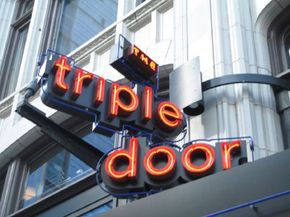
For live music, it would be hard to top the Triple Door (216 Union St) or Dimitriou's Jazz Alley (2033 Sixth Ave). An overhauled vaudeville theater from the 1920s, the Triple Door brings in top-name artists of all stripes, while Jazz Alley guarantees appearances by some of the top performers in that genre.
The Pampas Room at the Mobil Travel Guide Three-Star El Gaucho Steakhouse (2505 First Ave) is a Copacabana-style cocktail lounge with music and dancing, and the upstairs bar is a draw for local professional athletes.
Techno music lovers and others who prefer DJs to live music often wind up at Club Medusa (2218 Western Ave). But serious trance dancers will want to visit Northwest Tekno at www.nwtekno.org or call 206-686-3151, a 24-hour electronic music event hotline.
Oliver's, in the Mobil Three-Star Mayflower Park Hotel (405 Olive Way), is a shoppers' oasis with a great martini bar. Closer to the Seattle Center, Tini Bigs Lounge (100 Denny Way) has a reputation for stiff pours and fine martinis. Try the Burning Man-Tini, a spicy blend of Mazama chili-pepper vodka, chocolate liqueur, and sweet cream.
The Baltic Room (1207 Pine St), on Capitol Hill, is a retro-glam lounge with dancing almost nightly. The old Tractor Tavern (5213 Ballard Ave NW, Ballard) offers an eclectic mix of live performances, including rock, country, and world music.
The Blue Moon Tavern (712 NE 45th St), in the U District, has been around since the Beat Generation of the 1950s, and ancient graffiti still covers its wooden booths. The centrally positioned wood-paneled bar, ringed with padded stools, is an excellent place to sit.
Some Seattle residents enjoy area casinos. The major establishments, all on suburban Native American land, offer a full roster of dining and live entertainment as well as poker tables and casino games. The best are south of the city: the Emerald Queen Casino (5700 Pacific Hwy E, Fife) and the Muckleshoot Casino (2402 Auburn Way S, Auburn).
Check out music listings in local publications. Seattle Weekly provides comprehensive nightlife coverage, as does the weekly Stranger, albeit with a decidedly more alternative curve. The daily Seattle Times also publishes a club guide in its Friday entertainment section.
After a long night on the town, you'll probably want to kick back and relax. Discover the best ways -- and the best places -- to unwind in Seattle on the next page.
It's not hard to find serenity in Seattle. Despite the frenetic, caffeine-inspired pace of downtown and Interstate 5, all you really have to do to get away is hop aboard a ferry or grab a patio table at one of the many seafood restaurants on Puget Sound.
You can take a short drive into the mountains, explore the wineries of suburban Woodinville, or disappear into one of the city's beautiful parks and gardens, such as the Washington Park Arboretum. These are all things that Seattleites themselves do to unwind, and visitors are well advised to follow their lead.
Advertisement
When you're feeling stressed, there's nothing quite like a ferry trip to Bainbridge Island, to Bremerton, or better yet, to bucolic Vashon Island. The boat trip from Pier 50 on the Alaskan Way waterfront is passenger-only, which means you'll be joined by hikers and bicyclists heading out to enjoy the island's little-traveled back roads through forests and farmland, past orchards, berry patches, and craftspeople's studios.
Insider's Guide: The Best of Relaxing & Unwinding in Seattle
Seattle isn't exactly a beach town -- the waters of Elliott Bay are cold year-round, and there's no surf to speak of -- but you can capture the sandy flavor at two-mile-long Alki Beach (2700 Alki Ave SW), at the northwestern tip of the West Seattle promontory opposite downtown Seattle. A long promenade is popular among joggers, bicyclists, and inline skaters, and in the evening, the strand is a favorite place for local teenagers to gather around bonfires.
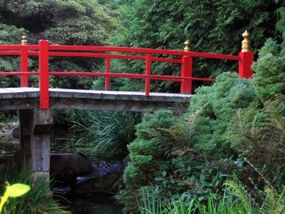
Another favorite urban getaway is the Washington Park Arboretum (2300 Arboretum Dr). Its 230 acres stretch north from East Madison Street to Union Bay, a Lake Washington inlet, and incorporates miles of trails through tall firs, blossoming azaleas, and rhododendrons (in spring), and other magnificent greenery. Don't miss the Japanese Garden (1075 Lake Washington Blvd), either, for its cherry blossoms in spring or its brilliantly turning maples in fall.
The International Fountain (305 Harrison St) is a good place to watch and sit aside its sleek, silver globe in the path of splashing arcs of water, which go off hourly and shoot up to 150 feet in the air.
The rainy climate dampens enthusiasm in some more traditional outdoor sports, including golf and tennis. Spring and summer, however, find golfers on the links. A couple of the more popular courses are the Jefferson Park Golf Club (4101 Beacon Ave S), an 18-hole par-70 public course open year-round, and Druids Glen Golf Course (29925 207th Ave), an 18-hole par-72 course with the backdrop of Mount Rainier and several holes requiring difficult shots over water right off the tee.
Diehard tennis players generally turn indoors to private clubs, but if you're an out-of-town visitor, you can call a week ahead to reserve an indoor or outdoor court at the Amy Yee Tennis Center (2000 Martin Luther King Jr. Way S; 206-684-4764).
Don't overlook the appeal of wineries or of a dinner train that can take you there. The Spirit of Washington Dinner Trail and its vintage railcars depart suburban Renton, at the south end of Lake Washington, every evening for a 22-mile run to Woodinville, not far from the north end of the lake. At Woodinville, passengers disembark for a wine tasting at the lovely Columbia winery.
Some people prefer to take a guided tour when visiting an unfamiliar city. The next page offers suggestions on some of the best of Seattle's organized tours.
The best way to tour Seattle might well be by Duck. An amphibious Second World War vehicle that travels by land or sea, the Duck visits the standard city sights then drops into Lake Union for a tour of Portage Bay and its houseboats. Seattle Duck Tours (516 Broad St) last 90 minutes and leave from near the Space Needle.
For boat tours of Seattle, try Washington State Ferries (Pier 50/52), Argosy Cruises (Pier 55), or Emerald City Charters (Pier 54).
Advertisement
To tour the city by bus, try Gray Line of Seattle or Customized Tours and Charter Service.
Seattle Walking Tours (425-226-7641) will provide you with an entertaining introduction to downtown Seattle at just $20 a head. Walkers meet at 10 am, any day but Sunday, at Westlake Plaza (Fourth Ave and Pine St).
Duse McLean's Seattle Walking Tours (425-885-3173) will show you the hidden corners of downtown as well as other neighborhoods, by request. Prices start around $15; they also meet at Westlake Plaza, by reservation.
Pike Place Market Tours will take you through the labyrinthine layout of the historic public market at 11 am and 2 pm, Wednesday through Sunday, beginning at First Avenue and Pike Street. The cost is only $8, but advance online reservations are required.
For flight-seeing tours, try Seattle Seaplanes, Old Thyme Aviation, or Over the Rainbow. The latter company takes guests up in hot-air balloons.
Private Eye on Seattle (206-365-3739) offers mystery and murder tours of Capitol Hill and the Queen Anne neighborhood, as well as a Haunted Happenings ghost tour. The three-hour trips, which combine driving and walking, cost $25.
Seattle Underground Tours (608 First Ave; 206-682-4646) will show you the original Seattle, upon which the new city was rebuilt following an 1889 fire, in a fascinating 90-minute walk.
Of course, you'll need a place to call home after your long days of touring the city. For some ideas, go to our Seattle hotels guide on the next page.
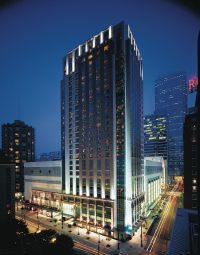
If it's grand luxury you want out of a Seattle hotel, go to the downtown area and look no further than the stately Mobil Travel Guide Four-Star Fairmont Olympic Hotel (411 University St), an Italian Renaissance-style classic built in 1924. The Mobil Three-Star Grand Hyatt Seattle (721 Pine St) and Mobil Three-Star Seattle Marriott Waterfront (2100 Alaskan Way) give it plenty of competition.
But posh boutique seems more the style of this city. The Mobil Three-Star Alexis Hotel (1007 First Ave), the Mobil Three-Star Inn at the Market (86 Pine St), and the Mobil Three-Star W Seattle Hotel (1112 Fourth Ave) fit the bill in this category.
Advertisement
If you seek economy lodging, take a look at Belltown's Ace Hotel (2423 First Ave) or the University District's College Inn (4000 University Way NE).
Some of the most wonderful lodgings in the greater Seattle area are beyond the urban core. The Mobil Three-Star Salish Lodge at Snoqualmie Falls (6501 Railroad Ave SE, Snowualmie), perched on a cliff above the waterfall, is a special place. So, too, is the Mobil Three-Star Willows Lodge (14580 NE 145th St) in Woodinville, which replicates the mood of a wilderness lodge.
Not surprisingly, rates increase with occupancy as weather improves. Thus you'll have to book well in advance between May and September. Off-season rates, especially on weekends (when business travelers get out of town), may be markedly reduced. (Seattle SuperSaver will get you 70 percent off rack rates at 48 hotels between November and March.) Keep in mind that you will be taxed 15.5 percent on top of the quoted rate: 8.6 percent state sales tax and 7 percent Seattle city hotel tax.
While seafood is the obvious culinary highlight of Seattle, there are many other excellent dining options for visitors. See our restaurants guide on the next page for suggestions.
Cuisine in the Seattle area has two particular highlights: seafood and Pacific Northwest regional cuisine. Seafood reigns supreme at restaurants like Elliott's Oyster House (Pier 56, 1201 Alaskan Way) for fresh Hood Canal oysters on the half shell; the Mobil Three-Star Ray's Boathouse (6049 Seaview Ave NW), near Ballard, for roasted Alaskan halibut with a squid-ink risotto and a lemongrass-coriander sauce; and Ivar's Salmon House (401 NE Northlake Way), on Lake Union near the University of Washington, where alder-smoked, barbecued salmon is served in a replica of a traditional Indian longhouse.
Top purveyors of Pacific Northwest cuisine include Mobil Three-Star Cascadia (2328 First Ave) in Belltown, where you can build a meal around Dungeness crab ravioli or grilled lamb with roast Mission figs; the Mobil Three-Star Dahlia Lounge (2001 Fourth Ave), downtown, which features spicy geoducks (a giant clam) or rotisserie-roasted duck; and Lark (926 12th Ave), near Capitol Hill, where mix-and-match small plates include pan-roasted quail with creamed corn and striped-bass tartare.
Outstanding French restaurants in Seattle include Mobil Two-Star Campagne (86 Pine St), whose roasted sea bass with tarragon and lemon is unforgettable, and Mobil Four-Star Rover's (2808 E Madison St). If they're available, try the Columbia River sturgeon or the venison medallions with lentils and parsnips.
Italian? Try Mobil Three-Star Al Boccalino (1 Yesler Way). Order the oven-roasted chicken breast, finished with a crimini mushroom prosciutto and a cognac cream sauce.
Many Seattleites insist the Mobil Two-Star Metropolitan Grill (820 Second Ave) is not only the best steakhouse in the city buts one of the best in the country. The New York peppercorn steak, topped with a green peppercorn demi-glace, is the stuff of local legend.
For great Chinese, look no further than the L.A. Seafood Restaurant (424 Seventh Ave S) in the International District. It's famous for its Cantonese-style seafood, such as pan-fried prawns with green pepper and black-bean sauce.
If you're trying to keep costs down, Pagliacci (550 Queen Anne Ave N) is a terrific place for the original cheese pizza, Canadian bacon and pineapple pizza, or spinach and chicken pizza.
In March and November, keep an eye out for Seattle's "25 for $25" promotions, which offer three set-price courses at 25 participating upscale restaurants around the urban area.
It's wise to have a reservation to avoid a long wait for a table, especially in summer and on weekends year-round. State sales tax of 8.6 percent will be added to your bill, and you should plan on tipping an additional 15 to 20 percent.
With so much to see and do in Seattle, you might want to plan ahead. The next section will help you do just that, with suggested itineraries for various areas of interest.
Seattle is a perfect destination because there are so many things to do. Whether you want to hit the touristy spots of Seattle like Pike Place Market and the Space Needle or are looking for off-the-beaten-track places like the Seattle Museum of Glass or the Rhododendron Species Botanical Garden, you'll find helpful tips in the suggested itineraries that follow.
Special Events & Attractions in Seattle
Special Events & Attractions in Seattle
Seattle is full of cool events and attractions to entice visitors of all kinds. The suggested itineraries below will help ensure that you hit the must-see attractions in Seattle.
1 day: As soon as you awaken, head to the venerable Pike Place Market (85 Pike St), which celebrates its 100th anniversary in 2007. Buy your espresso, fresh fruit, and pastries from the vendors there, and don't miss the show at the Pike Place Fish Market (86 Pike Place), whose fishmongers have learned to enjoy an otherwise rather smelly job by tossing 20-pound salmon back and forth to one another -- and sometimes to shocked tourists.
Saved from demolition by citizen action in the early 1970s, the nine-acre Pike Place Market Historic District embraces nearly 300 businesses, including 40 restaurants and hundreds of farmers' and craftspeople's stalls.
Head down the back stairs, through a maze of shops, and descend the 155-step Pike Hillclimb to reach the Seattle Waterfront -- a mishmash of fish bars and ferry docks, nautical shops and excursion boats, barnacle-encrusted piers and import stores.
At Pier 59, the Seattle Aquarium (1483 Alaskan Way) offers an undersea viewing dome on Elliott Bay. The Bell Street Pier 66 has a maritime museum, restaurants, and small-craft marina, and from Pier 70, a trail climbs through the new $60 million Olympic Sculpture Park.
Stop for a quick seafood lunch at one of the ubiquitous short-order fish restaurants, such as the delicious chowder at Ivar's Acres of Clams (1001 Alaskan Way) or the seared fresh lingcod from Anthony's Bell Street Diner (2201 Alaskan Way).
Retrace your route aboard the Waterfront Streetcar to Pier 52, where you can board a Washington State Ferry for the 35-minute commuter run to Bainbridge Island. Boats depart every 45 to 60 minutes. On your return, you can still catch a first-come, first-served, late-afternoon Seattle Underground Tour in Pioneer Square (608 First Ave).
If it's a summer evening, chances are good the Seattle Mariners are in town. Catch a major-league baseball game and enjoy a hot-dog dinner at Safeco Field, just south of Pioneer Square.
2 days: Start your day at Westlake Center, downtown Seattle's shopping hub, and board the monorail for the one-mile trip to Seattle Center (between Broad and Mercer sts, First Ave N and Fifth Ave N). Ride the elevator to the observation deck of the Space Needle (400 Broad St); during the weekend, the restaurant here is a great place for a brunch.
Back on the ground, if you love popular culture, you'll want to spend several hours admiring the Pacific Northwest's music history at the Experience Music Project museum (325 Fifth Ave N). And check out the adjoining, newly opened Science Fiction Museum (325 Fifth Ave N) to pay tribute to this genre of literature and film.
The afternoon would be a good time to visit the Hiram M. Chittenden Locks (3015 NW 54th St) and watch the boats passing between Puget Sound and Lake Union. Afterward, browse the shops of the nearby Ballard neighborhood (centered around NW Market St and 15th Ave NW).
Enjoy dinner in one of the fine restaurants of the Belltown District, such as Chef Kerry Sear's Northwest tasting menus at Mobil Travel Guide Three-Star Cascadia (2328 First Ave), then pop into a bar or nightclub for after-meal music. A favorite is Tula's (2214 Second Ave), the city's best place to hear homegrown jazz.
3 days: Get out of town. South is Tacoma, with its Washington State History Museum (1911 Pacific Ave) and Museum of Glass (1801 E Dock St), a showcase for the work of famed native son and glassmaker Dale Chihuly.
North is Everett, where Boeing still builds its 747 jetliners in the world's largest building. Tours begin at the Future of Flight Aviation Center (8415 Paine Field Blvd, Mukilteo).
Northeast is Redmond, where the fascinating Microsoft Visitor Center (4420 148th Ave NE, Building 127) recounts how college dropout Bill Gates and his friend, Paul Allen, founded Microsoft in 1975 envisioning "a personal computer on every desk and in every home."
If you're more inclined to sports and recreation, drive east into the Cascades to hike or (in winter) to ski. Snoqualmie Pass is barely an hour from Seattle via Interstate 90; Mount Rainier National Park is only slightly further to the southeast.
If water is more your medium, you can go sailing or paddling on any of the waters surrounding the metropolis. A good option is the Northwest Outdoor Center (2100 Westlake Ave N) on Lake Union, which has more than 100 kayaks available for rent. (They go quickly on good weather days.)
Or just take a stroll through Seattle's Washington Park Arboretum (2300 Arboretum Dr, north of E Madison S), a spectacular 230-acre reserve that is home to 10,000 trees, shrubs, and other plants.
Culture in Seattle
The number of cultural outlets -- especially art museums and galleries -- in Seattle is astounding. Use the following itineraries to help narrow your focus.
1 day: The Seattle Art Museum is the best place to start an art tour of Seattle. Then head to the galleries of Pioneer Square, the best are the Linda Hodges Gallery (316 First Ave S), the Greg Kucera Gallery (212 Third Ave E), and the Davidson Galleries (310 S Washington St and 313 Occidental Ave St).
Then head east, on South Main Street, to the International District, Seattle's nearest approximation of a Chinatown. It's worth a visit not only to the Wing Luke Asian Museum (407 Seventh Ave S) to see history and art displays on ten separate Asian immigrant groups; you'll also want to spend a good hour browsing in Uwajimaya (600 Fifth Ave S), the largest Asian grocery and gift store in the Northwest.
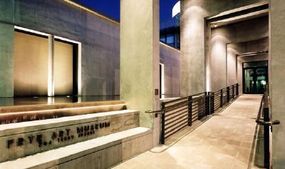
After a sushi or dim sum lunch, head over to the Frye Art Museum (704 Terry Ave) to view 19th- and 20th-century German, French, and American paintings and sculptures for free. You can also stroll through the courtyard, which has a reflecting pool and waterfall.
In the evening, check out the cultural events at the Seattle Center, or traipse over to the delightful Teatro ZinZanni (2301 Sixth Ave) for Seattle's best dinner theater, billed as a place "where the Moulin Rouge meets Cirque du Soleil." Celebrated chef Tom Douglas changes the four-course menu nightly.
2 days: You'll want to start out at Capitol Hill's Seattle Asian Art Museum (1400 E Prospect St), focusing especially on the Japanese, Chinese, and Korean collections.
Detour over to Howard House (604 Second Ave) to view contemporary paintings, sculptures, and other works from some of the best younger Seattle artists.
Then browse the unique counterculture shops along Broadway in the Capitol Hill neighborhood, grabbing a bite of lunch before heading north to the University of Washington for afternoon visits to the Henry Gallery (15th Ave NE and NE 41st St) and the Burke Museum (17th Ave NE and NE 45th St). Then indulge in a halibut-avocado taco -- and perhaps a brief kayak trip -- at the Agua Verde Cafe & Paddle Club (1303 NE Boat St) on Lake Union close by campus.
A good evening excursion, especially after enjoying the collections at the Burke, is the dinner cruise to Tillicum Village (2992 SW Avalon), a replica Native American village on tiny Blake Island. The $69 package includes a salmon dinner and traditional dancing. Contact Argosy Cruises on Pier 55.
3 days: Drive today to Tacoma, only a half-hour south if you avoid rush hour. The highlight is the Seattle Museum of Glass (1801 E Dock St), inspired by Tacoma native Dale Chihuly and dedicated to exhibiting glass and other contemporary art from around the world. Visitors also enjoy watching a resident team of glass blowers in the museum's Hot Shop.
Chihuly himself created the Bridge of Glass, a tunnel of light and color that connects the Museum of Glass across an eight-lane highway to the Washington State History Museum (1911 Pacific Ave).
There's more Chihuly art in the rotunda of the Beaux-Arts Union Station (1717 Pacific Ave), built in 1911 and now a federal courthouse, and in the Tacoma Art Museum (1701 Pacific Ave). All structures are within two blocks of one another.
While you're in Tacoma, don't miss a visit to the Pantages Theater (901 Broadway Plaza), a masterfully restored relic of the old vaudeville circuit built in 1918. W.C. Fields, Mae West, Will Rogers, and Harry Houdini all performed here. The Pantages is part of the Broadway Center for the Performing Arts (901 Broadway), which also incorporates the 1918 Rialto Theater (905 Broadway) and the Theatre on the Square (901 Broadway).
Architecture & Landmarks in Seattle
Architecture & Landmarks in Seattle
From modern buildings to early 20th-century Victorian homes, the architecture in Seattle is varied. Follow these itineraries when exploring the city's many landmarks:
1 day: Start your walk at Pioneer Square (James St and Yesler Way). Stop by Smith Tower (506 2nd Ave), which debuted in 1914, contains 33 floors, and was the tallest building for 55 years until 1969. It also has a 10-foot diameter glass ball on top that flashes the hour and quarter-hour at night with red, white, and blue lights.
Proceed north up Second Avenue to the Seattle Art Museum (100 University St), a five-story postmodern structure that opened in 1991, designed by husband-and-wife architectural team Robert Venturi and Denise Scott. Portland architech Brad Cloepfil headed the design team of the new glass-and-stainless-steel structure, just north of the existing one.
Stunning nearby skyscrapers include the 76-floor Columbia Center (Fourth Ave and Columbia St), the tallest building in the Pacific Northwest; Rainier Square (Fourth Ave and University St); and the US Bank Centre (Sixth Ave and Union St). In their midst is Freeway Park (Sixth Ave and Seneca St), the first major American park to be built directly over an interstate highway. Its five acres boast lawns, gardens, waterfalls, and fountains.
2 days: From Pike Place Market, descend to the waterfront and follow North Alaskan Way to Pier 70. It's a pleasant morning stroll through the brand-new, 8-1/2-acre Olympic Sculpture Park (Elliott and Western Ave), whose Z-shaped pedestrian trail climbs a hillside to the Belltown District. Works from the Seattle Art Museum's sculpture collection are carefully placed in a landscape of aquatic terraces, hardwood and evergreen trees, along with a special-events pavilion and an outdoor amphitheater.
Continue through the Belltown District to the Seattle Center. The 605-foot-tall Space Needle (400 Broad St) was a smash hit at the 1962 World's Fair. Built for just $4.5 million, the building underwent a $20 million revitalization in 2000 and easily withstood a 6.8 earthquake in 2001.
Today the Space Needle looks positively conservative next to the controversial Experience Music Project (325 Fifth Ave N), built by Frank Gehry in 2000. Gehry -- well known for such projects as the Guggenheim Museum in Bilbao, Spain, and the Walt Disney Concert Hall in Los Angeles -- didn't get a warm reception for this unique structure, with curvaceous lines and bizarre metallic colors that to some seem totally out of harmony with its environment. Nevertheless, it's one of Seattle's major architectural conversation pieces.
Grab a cab or a city bus to the top of Queen Anne Hill, a steep nearby rise with an absolutely stunning perspective on the Space Needle. There are many early 20th-century Victorian homes here, and a wander through the hilltop neighborhood makes for a pleasant afternoon and evening, if you stay to dine in any of several fine restaurants.
3 days: The exceptional architecture on the 693-acre University of Washington (between 15th Ave NE, NE 45th St and Montlake Blvd) campus makes this a terrific all-morning destination. At its present site overlooking Lake Washington since 1895, the campus owes much of its modern appearance to early 20th-century architect Carl Gould, who drew up a design plan in 1915.
Highlights include the first campus building, Denny Hall, built in French Renaissance style in 1895 with round turrets and candle-snuffer roofs; the 1895 Observatory, still open to the public for night viewing; the Architecture Hall, constructed for the Alaska-Yukon-Pacific Exposition of 1909; Gould's oh-so-gothic Suzzallo Library (1926), with Thought, Inspiration, and Mastery looming above the west entrance; and Smith Hall (1940), where 28 grotesques stand as symbols of primitive need, wisdom, war, weather, and magic. A Medicinal Herb Garden, perhaps the largest of its type in the United States, was built in 1911 and features architectural details typical of medieval Italian gardens.
Look around the off-campus "U District," grab some lunch, then spend your afternoon exploring Seattle neighborhoods. There are some wonderful old homes located south of campus, across the ship canal in Montlake, Broadmoor, and Madison Park, and northeast of campus in Laurelhurst and Windermere.
1-, 2-, and 3-Day Suggested Itineraries for Shopping in Seattle
From classics like Nordstrom to crafty finds in Pike Place Market, Seattle offers different types of shopping excursions to suit all travelers. Here are some suggested itineraries:
1 day: Focus on the heart of downtown -- including, of course, Nordstrom (500 Pine St). The chic department store has been a service-oriented customer favorite almost since Swedish immigrant John Nordstrom founded it as a shoe store in 1901. Adjoining "Nordy's" is Westlake Center (Fourth Ave and Pine St), with numerous fine shops on its four floors, capped by a food court. Other high-end retail stores in the downtown area include Macy's (300 Pine St) and NikeTown (1500 Sixth Ave). Meanwhile, Pacific Place (600 Pine St) and Rainier Square (1333 Fifth Ave) both house numerous prestigious retail establishments.
This is your day, as well, to explore the Pike Place Market (85 Pike St). Start at "Rachel," the famous bronze pig, and spend a few minutes being entertained by the fishmongers of the Pike Place Fish Market (86 Pike Place) as they toss large salmon back and forth from one to another and, sometimes, to a shocked onlooker. Then visit the farmers market, the craftspeople, the importers, and much more.
2 days: Check out the art and antique galleries in the Pioneer Square area, including those specializing in Native American art. Grab a cup of coffee and a sandwich in the Grand Central Building (214 First Ave S), which houses 17 shops and connects to the Seattle Underground. Drop into Elliott Bay Book Company (101 S Main St) to find a book by a local author.
Then wander a few blocks into the International District (4th Ave and Yesler Way), which is home to one of the largest and most vibrant Asian communities in the United States. Uwajimaya (600 Fifth Ave S) is a huge store and cooking school -- part Pan-Asian grocery, part gift-and-housewares shop -- that attracts anyone seeking a strong dose of Asian culture. Nearby, the KOBO Gallery (604 S Jackson St) presents an eclectic collection of Japanese crafts and Northwest arts.
Later, venture toward Lake Union to find the flagship store of REI (222 Yale Ave N), an outdoor-recreation and equipment specialist and the country's largest consumer cooperative.
3 days: Drive across Lake Washington to Lincoln Square (700 Bellevue Way NE), a twin-tower, 42-story, mixed-use complex that opened only in late 2005. Its retail space almost dwarfs the older Bellevue Square, which has 200 shops of its own connected to Lincoln Square by a sky bridge. Bellevue Square is also home to the Bellevue Arts Museum (510 Bellevue Way NE), whose exhibits focus specifically on leading Northwest artisans.
Among other suburban shopping centers, Northgate Mall (401 NE Northgate Way), designed by Space Needle architect John Graham, was considered the nation's first regional shopping mall when it opened in 1950. It features anchor stores, like Macy's and Gottschalks, and more than 120 specialty shops.
1-, 2-, and 3-Day Suggested Itineraries for Nightlife & Entertainment in Seattle
1-, 2-, and 3-Day Suggested Itineraries for Nightlife & Entertainment in Seattle
You won't be at a loss for nightlife and entertainment options in Seattle, especially if it's live music you seek. See the suggested itineraries below for guidance.
1 day: Get in the mood to rock down with an afternoon visit to the Experience Music Project and its Sky Church Performance Hall (325 Fifth Ave). Then return downtown to see who's playing at the Triple Door (216 Union St) or the Showbox (1426 First Ave), a nightclub within easy shouting distance of the Pike Place Market.
Afterward, stroll back down First Avenue into Belltown, checking out the action at spots like the Crocodile Cafe (2200 Second Ave), Club Medusa (2218 Western Ave), Bada Lounge (2230 First Ave), or The Pampas Room at the Mobil Travel Guide Three-Star El Gaucho Steakhouse (2505 First Ave). A great spot for a late-night bite, French-style -- say a charcuterie plate of cheeses and pates -- is Le Pichet (1933 1st Ave).
2 days: Jazz it up. The dinner show at Dimitriou's Jazz Alley (2033 Sixth Ave) guarantees a good show with top-flight entertainment; in late summer 2006 alone, the lineup included Marian McPartland, Kenny Rankin, Lee Ritenour, Dave Grusin, Oscar Peterson, Karrin Allyson, and Manhattan Transfer. Should you come for dinner, you can't go wrong ordering the maple-glazed pork chop with savory bread pudding. To see outstanding regional jazz talent, it's only six blocks to Tula's (2214 Second Ave), where you can also enjoy a late-night snack.
3 days: Catch a performance of the Seattle Symphony at beautiful Benaroya Hall (200 University St). The symphony is well-known for its interpretations of classical American composers. Next door is one of Seattle's favorite restaurants, Mobil Travel Guide Three-Star Wild Ginger (1401 Third Ave), where the young mountain lamb satay, marinated in garlic and served with a peanut sauce, never goes out of style.
If there's nothing on the calendar here, consider a dinner cruise to Tillicum Village (2992 SW Avalon), a replica Salish village on tiny Blake Island, to enjoy a grilled salmon buffet and Native American dancing. You can catch a nightly boat departure from Pier 55.
1-, 2-, and 3-Day Suggested Itineraries for Relaxing & Unwinding in Seattle
1-, 2-, and 3-Day Suggested Itineraries for Relaxing & Unwinding in Seattle
From beautiful gardens to topnotch wineries, there are dozens of ways to de-stress in Seattle. Here are three days worth of ideas:
1 day: Rain or shine, enjoy a walk along the shore of Puget Sound or Lake Washington. A good choice is the Magnolia neighborhood's Discovery Park (3801 W Government Way), a 534-acre urban forest reserve with two miles of beach trail, an 1881 lighthouse, a historic Army fort, and the Daybreak Star Indian Cultural Center.
Alternatives include West Seattle's Lincoln Park (8011 Fauntleroy Way SW), a heavily wooded park whose rocky beaches are strewn with tidepools, and Seward Park (Lake Washington Blvd S and S Orcas St), a 300-acre peninsula that juts into Lake Washington and holds urban Seattle's largest virgin forest.
Later on, here's a tranquil alternative to the ferry: a 2-1/2-hour sunset sail aboard a 70-foot yacht from Pier 54. Emerald City Charters offer nightly departures from May to mid-October. Afterward, drop into Elliott's Oyster House (1201 Alaskan Way) on Pier 56 for a fresh swordfish steak.
2 days: If you're into flowers and gardens, you won't want to miss a pair of horticultural highlights at the corporate headquarters of the forest-products giant Weyerhaeuser Company (Weyerhaeuser Way S, Federal Way). The Rhododendron Species Botanical Garden is the largest of its kind in the world, with more than 500 species and hybrids on 22 acres. (Spring is the best time to visit, but some plants bloom year-round.) Nearby, the Pacific Rim Bonsai Collection is a place to learn techniques for pruning and propagating a miniature garden, such as a 1,000-year-old dwarf Sierra juniper on display.
For more of that Japanese flavor, detour to Kubota Gardens (9817 55th Ave S) on your return to downtown Seattle. This exotic oasis in the rarely visited Rainier Beach neighborhood has paths that wind through carefully tended pines, lawns, ponds, and waterfalls.
In the evening, enjoy a quiet dinner at a restaurant like Mobil Three-Star Ray's Boathouse (6049 Seaview Ave NW), where you can dine on Chatham Strait sablefish with sake kasu while enjoying sunset over the Shilshole Bay marina.
3 days: Who doesn't love a zoo? You can easily spend a morning at the Woodland Park Zoo (Fremont Ave N and N 50th St), nationally praised for its natural-environment exhibits. The African Savannah, Tropical Rain Forest, and Elephant Forest are of special note.
Then head across Lake City Way to suburban Woodinville, 20 miles northeast of Seattle. Woodinville has ironically become a major wine destination despite the fact that you won't find any real vineyards here. Chateau Ste. Michelle (14111 NE 145th St), Washington's largest winery, set the tone by producing wines from grapes grown in the drier eastern part of the state, primarily the Yakima Valley.
The Redhook Brewery (14300 NE 145th St) and Columbia Winery (14030 NE 145th St) are nearby; in fact, 28 wineries now call Woodinville home. Scheduled for completion in 2007 is the 18-acre Woodinville Village, which will incorporate some of these wineries into a Tuscan-style community around a central piazza.
Cap your day with dinner (at the Mobil Three-Star Barking Frog or the renowned Mobil Four-Star Herbfarm) and a Japanese-style spa treatment at the luxe Mobil Three-Star Willows Lodge (14580 NE 145th St).
Whatever it is you desire -- whether it's great food, outdoor splendor, fine art, or cutting-edge music -- you'll find it in Seattle. No wonder this city has become such a hot tourist destination.
John Gottberg is the author of Hidden Seattle, published by Ulysses Press, and is the author or co-author of 20 other travel guides for such publishers as Frommer's and Lonely Planet. He is a former editor for the Insight Guides, the Michelin guides, and The Los Angeles Times travel section. His travel articles have appeared in National Geographic Traveler, Travel + Leisure, and Islands. Raised in the Pacific Northwest, John graduated from the University of Washington and has worked as a reporter and an editor at both major Seattle newspapers, The Times and Post-Intelligencer.
Then head east, on South Main Street, to the International District, Seattle's nearest approximation of a Chinatown. It's worth a visit not only to the Wing Luke Asian Museum (407 Seventh Ave S) to see history and art displays on ten separate Asian immigrant groups; you'll also want to spend a good hour browsing in Uwajimaya (600 Fifth Ave S), the largest Asian grocery and gift store in the Northwest.
After a sushi or dim sum lunch, head over to the Frye Art Museum (704 Terry Ave) to view 19th- and 20th-century German, French, and American paintings and sculptures for free. You can also stroll through the courtyard, which has a reflecting pool and waterfall.
In the evening, check out the cultural events at the Seattle Center, or traipse over to the delightful Teatro ZinZanni (2301 Sixth Ave) for Seattle's best dinner theater, billed as a place "where the Moulin Rouge meets Cirque du Soleil." Celebrated chef Tom Douglas changes the four-course menu nightly.
2 days: You'll want to start out at Capitol Hill's Seattle Asian Art Museum (1400 E Prospect St), focusing especially on the Japanese, Chinese, and Korean collections.
Detour over to Howard House (604 Second Ave) to view contemporary paintings, sculptures, and other works from some of the best younger Seattle artists.
Then browse the unique counterculture shops along Broadway in the Capitol Hill neighborhood, grabbing a bite of lunch before heading north to the University of Washington for afternoon visits to the Henry Gallery (15th Ave NE and NE 41st St) and the Burke Museum (17th Ave NE and NE 45th St). Then indulge in a halibut-avocado taco -- and perhaps a brief kayak trip -- at the Agua Verde Cafe & Paddle Club (1303 NE Boat St) on Lake Union close by campus.
A good evening excursion, especially after enjoying the collections at the Burke, is the dinner cruise to Tillicum Village (2992 SW Avalon), a replica Native American village on tiny Blake Island. The $69 package includes a salmon dinner and traditional dancing. Contact Argosy Cruises on Pier 55.
3 days: Drive today to Tacoma, only a half-hour south if you avoid rush hour. The highlight is the Seattle Museum of Glass (1801 E Dock St), inspired by Tacoma native Dale Chihuly and dedicated to exhibiting glass and other contemporary art from around the world. Visitors also enjoy watching a resident team of glass blowers in the museum's Hot Shop.
Chihuly himself created the Bridge of Glass, a tunnel of light and color that connects the Museum of Glass across an eight-lane highway to the Washington State History Museum (1911 Pacific Ave).
There's more Chihuly art in the rotunda of the Beaux-Arts Union Station (1717 Pacific Ave), built in 1911 and now a federal courthouse, and in the Tacoma Art Museum (1701 Pacific Ave). All structures are within two blocks of one another.
While you're in Tacoma, don't miss a visit to the Pantages Theater (901 Broadway Plaza), a masterfully restored relic of the old vaudeville circuit built in 1918. W.C. Fields, Mae West, Will Rogers, and Harry Houdini all performed here. The Pantages is part of the Broadway Center for the Performing Arts (901 Broadway), which also incorporates the 1918 Rialto Theater (905 Broadway) and the Theatre on the Square (901 Broadway).
Architecture & Landmarks in Seattle
Architecture & Landmarks in Seattle
From modern buildings to early 20th-century Victorian homes, the architecture in Seattle is varied. Follow these itineraries when exploring the city's many landmarks:
1 day: Start your walk at Pioneer Square (James St and Yesler Way). Stop by Smith Tower (506 2nd Ave), which debuted in 1914, contains 33 floors, and was the tallest building for 55 years until 1969. It also has a 10-foot diameter glass ball on top that flashes the hour and quarter-hour at night with red, white, and blue lights.
Proceed north up Second Avenue to the Seattle Art Museum (100 University St), a five-story postmodern structure that opened in 1991, designed by husband-and-wife architectural team Robert Venturi and Denise Scott. Portland architech Brad Cloepfil headed the design team of the new glass-and-stainless-steel structure, just north of the existing one.
Stunning nearby skyscrapers include the 76-floor Columbia Center (Fourth Ave and Columbia St), the tallest building in the Pacific Northwest; Rainier Square (Fourth Ave and University St); and the US Bank Centre (Sixth Ave and Union St). In their midst is Freeway Park (Sixth Ave and Seneca St), the first major American park to be built directly over an interstate highway. Its five acres boast lawns, gardens, waterfalls, and fountains.
2 days: From Pike Place Market, descend to the waterfront and follow North Alaskan Way to Pier 70. It's a pleasant morning stroll through the brand-new, 8-1/2-acre Olympic Sculpture Park (Elliott and Western Ave), whose Z-shaped pedestrian trail climbs a hillside to the Belltown District. Works from the Seattle Art Museum's sculpture collection are carefully placed in a landscape of aquatic terraces, hardwood and evergreen trees, along with a special-events pavilion and an outdoor amphitheater.
Continue through the Belltown District to the Seattle Center. The 605-foot-tall Space Needle (400 Broad St) was a smash hit at the 1962 World's Fair. Built for just $4.5 million, the building underwent a $20 million revitalization in 2000 and easily withstood a 6.8 earthquake in 2001.
Today the Space Needle looks positively conservative next to the controversial Experience Music Project (325 Fifth Ave N), built by Frank Gehry in 2000. Gehry -- well known for such projects as the Guggenheim Museum in Bilbao, Spain, and the Walt Disney Concert Hall in Los Angeles -- didn't get a warm reception for this unique structure, with curvaceous lines and bizarre metallic colors that to some seem totally out of harmony with its environment. Nevertheless, it's one of Seattle's major architectural conversation pieces.
Grab a cab or a city bus to the top of Queen Anne Hill, a steep nearby rise with an absolutely stunning perspective on the Space Needle. There are many early 20th-century Victorian homes here, and a wander through the hilltop neighborhood makes for a pleasant afternoon and evening, if you stay to dine in any of several fine restaurants.
3 days: The exceptional architecture on the 693-acre University of Washington (between 15th Ave NE, NE 45th St and Montlake Blvd) campus makes this a terrific all-morning destination. At its present site overlooking Lake Washington since 1895, the campus owes much of its modern appearance to early 20th-century architect Carl Gould, who drew up a design plan in 1915.
Highlights include the first campus building, Denny Hall, built in French Renaissance style in 1895 with round turrets and candle-snuffer roofs; the 1895 Observatory, still open to the public for night viewing; the Architecture Hall, constructed for the Alaska-Yukon-Pacific Exposition of 1909; Gould's oh-so-gothic Suzzallo Library (1926), with Thought, Inspiration, and Mastery looming above the west entrance; and Smith Hall (1940), where 28 grotesques stand as symbols of primitive need, wisdom, war, weather, and magic. A Medicinal Herb Garden, perhaps the largest of its type in the United States, was built in 1911 and features architectural details typical of medieval Italian gardens.
Look around the off-campus "U District," grab some lunch, then spend your afternoon exploring Seattle neighborhoods. There are some wonderful old homes located south of campus, across the ship canal in Montlake, Broadmoor, and Madison Park, and northeast of campus in Laurelhurst and Windermere.
1-, 2-, and 3-Day Suggested Itineraries for Shopping in Seattle
From classics like Nordstrom to crafty finds in Pike Place Market, Seattle offers different types of shopping excursions to suit all travelers. Here are some suggested itineraries:
1 day: Focus on the heart of downtown -- including, of course, Nordstrom (500 Pine St). The chic department store has been a service-oriented customer favorite almost since Swedish immigrant John Nordstrom founded it as a shoe store in 1901. Adjoining "Nordy's" is Westlake Center (Fourth Ave and Pine St), with numerous fine shops on its four floors, capped by a food court. Other high-end retail stores in the downtown area include Macy's (300 Pine St) and NikeTown (1500 Sixth Ave). Meanwhile, Pacific Place (600 Pine St) and Rainier Square (1333 Fifth Ave) both house numerous prestigious retail establishments.
This is your day, as well, to explore the Pike Place Market (85 Pike St). Start at "Rachel," the famous bronze pig, and spend a few minutes being entertained by the fishmongers of the Pike Place Fish Market (86 Pike Place) as they toss large salmon back and forth from one to another and, sometimes, to a shocked onlooker. Then visit the farmers market, the craftspeople, the importers, and much more.
2 days: Check out the art and antique galleries in the Pioneer Square area, including those specializing in Native American art. Grab a cup of coffee and a sandwich in the Grand Central Building (214 First Ave S), which houses 17 shops and connects to the Seattle Underground. Drop into Elliott Bay Book Company (101 S Main St) to find a book by a local author.
Then wander a few blocks into the International District (4th Ave and Yesler Way), which is home to one of the largest and most vibrant Asian communities in the United States. Uwajimaya (600 Fifth Ave S) is a huge store and cooking school -- part Pan-Asian grocery, part gift-and-housewares shop -- that attracts anyone seeking a strong dose of Asian culture. Nearby, the KOBO Gallery (604 S Jackson St) presents an eclectic collection of Japanese crafts and Northwest arts.
Later, venture toward Lake Union to find the flagship store of REI (222 Yale Ave N), an outdoor-recreation and equipment specialist and the country's largest consumer cooperative.
3 days: Drive across Lake Washington to Lincoln Square (700 Bellevue Way NE), a twin-tower, 42-story, mixed-use complex that opened only in late 2005. Its retail space almost dwarfs the older Bellevue Square, which has 200 shops of its own connected to Lincoln Square by a sky bridge. Bellevue Square is also home to the Bellevue Arts Museum (510 Bellevue Way NE), whose exhibits focus specifically on leading Northwest artisans.
Among other suburban shopping centers, Northgate Mall (401 NE Northgate Way), designed by Space Needle architect John Graham, was considered the nation's first regional shopping mall when it opened in 1950. It features anchor stores, like Macy's and Gottschalks, and more than 120 specialty shops.
1-, 2-, and 3-Day Suggested Itineraries for Nightlife & Entertainment in Seattle
1-, 2-, and 3-Day Suggested Itineraries for Nightlife & Entertainment in Seattle
You won't be at a loss for nightlife and entertainment options in Seattle, especially if it's live music you seek. See the suggested itineraries below for guidance.
1 day: Get in the mood to rock down with an afternoon visit to the Experience Music Project and its Sky Church Performance Hall (325 Fifth Ave). Then return downtown to see who's playing at the Triple Door (216 Union St) or the Showbox (1426 First Ave), a nightclub within easy shouting distance of the Pike Place Market.
Afterward, stroll back down First Avenue into Belltown, checking out the action at spots like the Crocodile Cafe (2200 Second Ave), Club Medusa (2218 Western Ave), Bada Lounge (2230 First Ave), or The Pampas Room at the Mobil Travel Guide Three-Star El Gaucho Steakhouse (2505 First Ave). A great spot for a late-night bite, French-style -- say a charcuterie plate of cheeses and pates -- is Le Pichet (1933 1st Ave).
2 days: Jazz it up. The dinner show at Dimitriou's Jazz Alley (2033 Sixth Ave) guarantees a good show with top-flight entertainment; in late summer 2006 alone, the lineup included Marian McPartland, Kenny Rankin, Lee Ritenour, Dave Grusin, Oscar Peterson, Karrin Allyson, and Manhattan Transfer. Should you come for dinner, you can't go wrong ordering the maple-glazed pork chop with savory bread pudding. To see outstanding regional jazz talent, it's only six blocks to Tula's (2214 Second Ave), where you can also enjoy a late-night snack.
3 days: Catch a performance of the Seattle Symphony at beautiful Benaroya Hall (200 University St). The symphony is well-known for its interpretations of classical American composers. Next door is one of Seattle's favorite restaurants, Mobil Travel Guide Three-Star Wild Ginger (1401 Third Ave), where the young mountain lamb satay, marinated in garlic and served with a peanut sauce, never goes out of style.
If there's nothing on the calendar here, consider a dinner cruise to Tillicum Village (2992 SW Avalon), a replica Salish village on tiny Blake Island, to enjoy a grilled salmon buffet and Native American dancing. You can catch a nightly boat departure from Pier 55.
1-, 2-, and 3-Day Suggested Itineraries for Relaxing & Unwinding in Seattle
1-, 2-, and 3-Day Suggested Itineraries for Relaxing & Unwinding in Seattle
From beautiful gardens to topnotch wineries, there are dozens of ways to de-stress in Seattle. Here are three days worth of ideas:
1 day: Rain or shine, enjoy a walk along the shore of Puget Sound or Lake Washington. A good choice is the Magnolia neighborhood's Discovery Park (3801 W Government Way), a 534-acre urban forest reserve with two miles of beach trail, an 1881 lighthouse, a historic Army fort, and the Daybreak Star Indian Cultural Center.
Alternatives include West Seattle's Lincoln Park (8011 Fauntleroy Way SW), a heavily wooded park whose rocky beaches are strewn with tidepools, and Seward Park (Lake Washington Blvd S and S Orcas St), a 300-acre peninsula that juts into Lake Washington and holds urban Seattle's largest virgin forest.
Later on, here's a tranquil alternative to the ferry: a 2-1/2-hour sunset sail aboard a 70-foot yacht from Pier 54. Emerald City Charters offer nightly departures from May to mid-October. Afterward, drop into Elliott's Oyster House (1201 Alaskan Way) on Pier 56 for a fresh swordfish steak.
2 days: If you're into flowers and gardens, you won't want to miss a pair of horticultural highlights at the corporate headquarters of the forest-products giant Weyerhaeuser Company (Weyerhaeuser Way S, Federal Way). The Rhododendron Species Botanical Garden is the largest of its kind in the world, with more than 500 species and hybrids on 22 acres. (Spring is the best time to visit, but some plants bloom year-round.) Nearby, the Pacific Rim Bonsai Collection is a place to learn techniques for pruning and propagating a miniature garden, such as a 1,000-year-old dwarf Sierra juniper on display.
For more of that Japanese flavor, detour to Kubota Gardens (9817 55th Ave S) on your return to downtown Seattle. This exotic oasis in the rarely visited Rainier Beach neighborhood has paths that wind through carefully tended pines, lawns, ponds, and waterfalls.
In the evening, enjoy a quiet dinner at a restaurant like Mobil Three-Star Ray's Boathouse (6049 Seaview Ave NW), where you can dine on Chatham Strait sablefish with sake kasu while enjoying sunset over the Shilshole Bay marina.
3 days: Who doesn't love a zoo? You can easily spend a morning at the Woodland Park Zoo (Fremont Ave N and N 50th St), nationally praised for its natural-environment exhibits. The African Savannah, Tropical Rain Forest, and Elephant Forest are of special note.
Then head across Lake City Way to suburban Woodinville, 20 miles northeast of Seattle. Woodinville has ironically become a major wine destination despite the fact that you won't find any real vineyards here. Chateau Ste. Michelle (14111 NE 145th St), Washington's largest winery, set the tone by producing wines from grapes grown in the drier eastern part of the state, primarily the Yakima Valley.
The Redhook Brewery (14300 NE 145th St) and Columbia Winery (14030 NE 145th St) are nearby; in fact, 28 wineries now call Woodinville home. Scheduled for completion in 2007 is the 18-acre Woodinville Village, which will incorporate some of these wineries into a Tuscan-style community around a central piazza.
Cap your day with dinner (at the Mobil Three-Star Barking Frog or the renowned Mobil Four-Star Herbfarm) and a Japanese-style spa treatment at the luxe Mobil Three-Star Willows Lodge (14580 NE 145th St).
Whatever it is you desire -- whether it's great food, outdoor splendor, fine art, or cutting-edge music -- you'll find it in Seattle. No wonder this city has become such a hot tourist destination.
John Gottberg is the author of Hidden Seattle, published by Ulysses Press, and is the author or co-author of 20 other travel guides for such publishers as Frommer's and Lonely Planet. He is a former editor for the Insight Guides, the Michelin guides, and The Los Angeles Times travel section. His travel articles have appeared in National Geographic Traveler, Travel + Leisure, and Islands. Raised in the Pacific Northwest, John graduated from the University of Washington and has worked as a reporter and an editor at both major Seattle newspapers, The Times and Post-Intelligencer.