Search-and-rescue operations in an urban environment present a unique challenge. It's not a single survivor floating in the ocean or a lost hiker in the wilderness. Disasters like Sept. 11 and Hurricane Katrina involve a variety of obstacles, which require a lot of equipment and specialists who know how to use it. To call the equipment cache for an urban search-and-rescue operation vast is quite an understatement. FEMA's USAR task force equipment list is more than 60 pages long and contains over 2,000 items [source: FEMA]. The list covers everything from structural shoring equipment to dog food and port-o-potties.
The days of using jacks to lift vehicles and chunks of concrete off an injured person are long gone. These days, USAR teams use airbag lifting systems to do the job. The flat Kevlar bags are inserted under the heavy object and inflated with an air pump. The largest deluxe bag systems are capable of lifting as much as 70 tons 20 inches off the ground at full inflation [source: Simplex]. In addition to the lifters, shoring equipment is necessary to make sure the passageways the teams create are stable and safe to travel into.
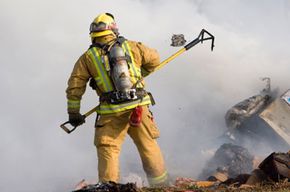
Traditional heavy demolition and construction equipment is key to any USAR operation. Concrete saws, jackhammers, chainsaws and hand tools like pry bars, axes and bolt cutters are just a few implements used on site. USAR teams use heavy-rigging gear like chains, cables, anchors and rope-hauling systems to remove larger pieces of collapsed building. By tying them to bulldozers and cranes, the large debris is moved slowly and safely. Laser range finders and wind detectors are on hand to judge distances and measure conditions on site. Heavy winds can delay a search because they can compromise the integrity of the structure and the safety of the search team.
Hazardous material equipment is also necessary to ensure the safety of the USAR workers. Teams use everything from special suits, gloves, masks and boot covers to oxygen and carbon monitoring systems that check the air quality to make sure no invisible dangers exist. Whenever any suspicious leaks or odors are detected, workers use radiation and chemical test kits to check the levels in the air.
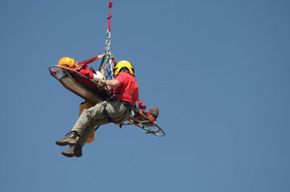
USAR teams are recommended to have at least three different visual search devices in their cache. Teams use snake-eye and fiber optic camera systems to get into places that the human eye can't reach. These cameras are attached to video relay monitors and sent into small crevices to search out survivors. If survivors are found, USAR workers insert breathing tubes to allow the trapped person a breath of air. They send backboards and rescue litters attached to rope hauling systems to stabilize the survivor.
Medical supplies are plentiful on USAR trucks. The teams are outfitted with the necessary medical equipment to deal with just about any scenario. Cervical collars, eye flushes, immunizations, pain medication, wound care kits and splints are only the tip of the iceberg for these mobile hospitals. USAR teams even pack defibrillators and endotracheal tubes in order to shock someone back to life or perform an emergency tracheotomy if necessary.
In addition to all the life-saving and construction equipment, there are all manner of communication systems as well as the ordinary everyday items used to keep the team going. Food, water, toilet paper, blankets, clipboards, paper, camera film, batteries and power generators are all necessary in order to keep the operation going full-time. Even crayons find their way onto the FEMA list -- they're used to mark concrete and stone.
In the next section, we'll dive into air and sea rescue.