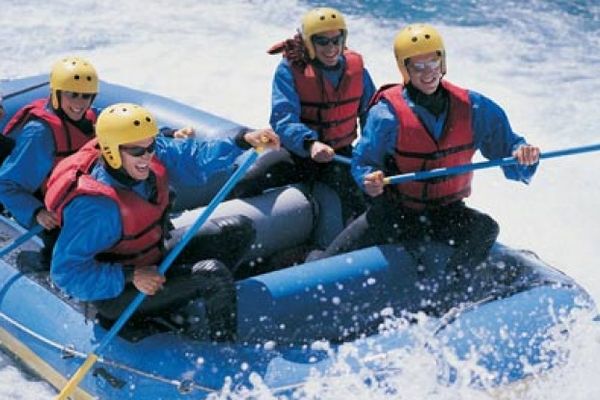
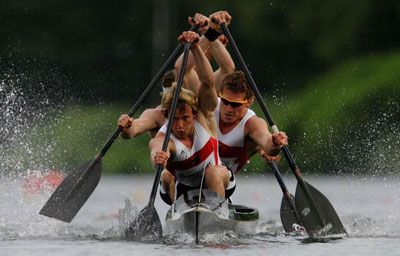
Anyone with an adventurous spirit can enjoy white-water rafting. But no matter what your age, you'll need to know how to choose the right river for your experience level. White-water rapids are rated for difficulty, and there are six levels of classification.
Class I and II rapids are best for families and beginners:
Class I: Class I rapids are categorized as the easiest. This is generally flat, moving water with few or no waves or obstructions. Very little steering is needed.
Class II: Class II rapids are slightly more difficult. This water may have medium-sized waves and may require some maneuvering around rocks.
For the more adventuresome novices and intermediate rafters, Class III and IV rapids provide technical challenges. Many confident beginners try Class III rapids on their first rafting trip.
Class III: Class III rapids have many moderate, irregular waves, fast currents and narrow passages. These rapids are less forgiving if you make a mistake. You may encounter large but easily navigable waves.
Class IV: Class IV rapids are very difficult and should be navigated by only those with advanced maneuvering skills. These rapids have cross-currents, fast and turbulent water and large, powerful waves.
Experts in search of a challenge will find the most challenging rapids in Classes V and VI.
Class V: Class V rapids are extremely difficult. These waters are intense and have powerful currents, cross-currents, large drops and holes as well as obstructed, turbulent rapids.
Class VI: Class VI rapids are impossible or almost impossible to navigate.
Rivers won't always fall easily into a classification and may surprise you with their difficulty. You'll also need to learn how to "read" the river from your raft and from the shore (called scouting).
The art of river reading involves looking at the different elements of the river to determine any possible dangers. Break down your read by first looking at the big picture, such as the direction of the current and scouting any hazards such as fallen trees or big rocks. Then scout out the details, such as available rest stops (known as eddies).
Rivers on the East Coast require more technical expertise than those on the West Coast, and have a greater number of boulders and rocks to navigate. West Coast rivers tend to have higher water volume and steeper descents. Be sure to pick a river that interests you -- you'll be looking at the scenery for the duration of your trip!
When planning an East Coast rafting adventure, some of the best river runs are the Ocoee River in Polk County, Tenn., which was home to the 1996 Olympic Canoe/Kayak White-water Slalom competition; the Nantahala River in Bryson City, N.C.; the Gauley River in Summersville, W.V. and the Chattooga River outside of Clayton, Ga. The Chattooga River, for the film buffs out there, is where "Deliverance" was shot.
On the West Coast, you'll want to explore Cache La Poudre and Gore Canyon in Colorado and Clarks Fork of the Yellowstone in Montana [source: GoogoBits].
Now that we know about rapids and some of the best rivers runs, let's talk about types of crafts used on whitewater.