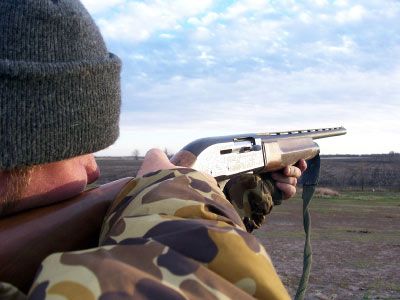
You've been lurking on the edge of this clearing all morning, since your arrival before sunrise. No signs of movement have caught your eye as you've scanned the forest. But now, there's something stirring on the horizon. As you focus your binoculars, you see the eight-point buck straight across from you, moving into the open space. But he's got to be nearly 1,000 yards (914 meters) away. There's no way you'll be able to get a decent shot from that great a distance. Or is there?
Long-range hunting is the way to do it. That's when you hunt from several hundred yards away through the use of a large-caliber rifle with a precise hand-loaded cartridge. Through this technique (and lots of practice) you can hit targets anywhere from 500 yards to more than a mile away (457 meters to 1.6 kilometers) [source: Lilja]. It's not a cheap pastime -- this precision sport requires a lot of pricey equipment.
Advertisement
Some of the necessary items include a long-range rifle (usually a bench-rester of considerable size and weight) and an optic of some sort, such as a rifle scope or binoculars to see the great lengths your rifle-projected bullets can span. For stability and precision, you should invest in a bench and sandbag on which to prop the rifle. Your bullets should be of the highest ballistic coefficient for accurate long-range shots. Finally, a drop chart will give you the details of bullet trajectory so you can set up your shot.
This approach has its supporters and detractors, just like many other forms of hunting. The controversy lies in determining whether or not long-range hunting is ethical. Some hunters live by a code of ethics that others don't. But when it comes to hunting, are some forms right and some wrong?
We'll start with arguments in favor of the pastime on the next page.
Advertisement