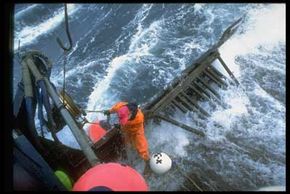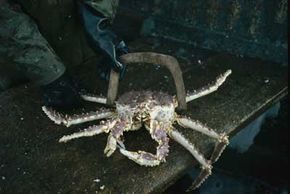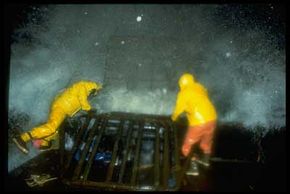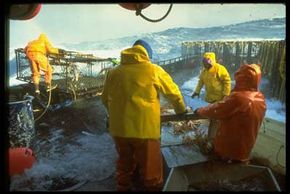
Crab fishing is no nine-to-five job. The daredevils who work this gig literally live at the office -- a vessel that, as it sloshes through the frigid waters, operates 24 hours a day, seven days a week, until the crab quota is filled.
It's no secret crab fishing is risky work, and, in fact, is one of the most dangerous jobs in the world. In the 1990s, it was reported that the Alaskan fishing industry typically saw 24 lives lost each year -- on only 34 vessels. That's the equivalent of 140 deaths per 100,000 workers, which was 20 times the national average for all U.S. jobs at that time. Of all the types of fishing done in Alaska, crab fishing was responsible for the majority of deaths [source: Centers for Disease Control and Prevention]. New regulations to protect fishermen have improved conditions, and between 2003 and 2008, there were only 11 deaths per year [source: Associated Press].
Advertisement
In these deadly conditions, a crab boat could spend three to four months out at sea. That said, it must carry everything its captain and deckhands need until it returns to port, including 800-pound crab cages, food, medical supplies and other equipment -- and of course room for the incoming crab. Given the treacherous working conditions and close quarters, captains are careful to select deckhands who'll add spunk (not spite) to long days and nights. This is a community, not just a workforce.
Floating city? Well, you might call it that. What is community like aboard a crab boat? How does it function away from land's medical care, food and supplies? Find out on the next few pages.
Advertisement