How to Survive a Plane Crash

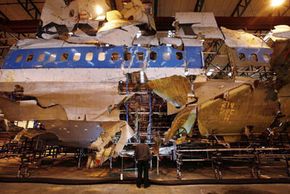
Peter Macdiarmid/Getty Images
The reconstructed remains of Pan Am flight 103 lie in a warehouse on January 15, 2008 in Farnborough, England.
See pictures of flight history.
It's every air traveler's nightmare. Sudden turbulence throws you backward. The beverage cart flies by and crashes into the rear of the cabin. You're losing altitude quickly, and your seatbelt is jammed between the seats. Oxygen masks drop from above, but you didn't pay attention to preflight instructions. People scream, pray and clutch each other as the plane descends downward at an improbable angle. You think you're going to die.
The good news is that an airplane crash doesn't necessarily mean certain death. In fact, of the 568 U.S. plane crashes between 1980 and 2000, more than 90 percent of crash victims survived [source: BBC].
Up Next |
In the event of an air disaster, there are things you can do that can increase your odds of living. Keeping a calm, cool head amidst panic and disorder isn't easy, but key to your chances. So are the clothes you wear, the luggage you bring and where you stow it. Some research even indicates that the seat you choose might help.
In this article, we'll fill you in on how you can best increase your odds of surviving a plane crash. We'll also learn a few common myths about crashes and reveal some harrowing true stories of survival.
Survival Tips and Crash Myths

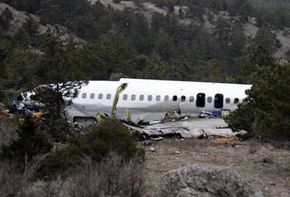
AFP/Stringer/Getty Images
View of the wreckage of the AtlasJet Airline MD-83 plane that crashed on the hills near the village of Cukuroren in the southwestern province of Isparta, Turkey.
The most common question asked of crash experts is "Is there a safest seat?" Official sources say that it makes no difference because no two plane crashes are alike. Popular Mechanics magazine did some exhaustive research that seems to point to the rear of the plane as the safest spot. They studied data of every U.S. commercial jet crash in the last 36 years and found that passengers in the rear of the plane are 40 percent more likely to survive than those in the first few rows [source: Popular Mechanics]. The Federal Aviation Administration's position is that there is no safest seat. The FAA also concluded in a 2005 report that there's no evidence that any one carrier is any safer than the next [source: FAA].
Survival Stories The Andes Accident On Friday the 13th in October 1972, a Uruguayan plane bound for Chile
crashed in the Andes mountains with 45 passengers on board. Most were
part of the Stella Maris College rugby team. Both wings were ripped off
after cloud cover triggered a premature descent. The fuselage crashed
into a mountain peak and came to rest in the snow.
Of the 45, 12 died in the initial crash and another five the next morning. The 26 survivors endured temperatures up to 30 degrees below zero, had minimal food and water and no first-aid supplies. Two weeks into the ordeal, an avalanche killed another eight survivors. With no animals or vegetation, they made the difficult decision to feed on the flesh of their fallen friends in order to survive. Believing hiking out was their only hope, several of the strongest remaining men made several trial runs before eventually spotting three men on horseback. They were able to convey their situation from across a river and after 72 days, rescue helicopters arrived. Sixteen of the initial 45 passengers survived. Their story was told in the 1993 film "Alive" [source: Viven]. |
In the event of a crash, there are things you can do to give you a better shot at making it out alive. Following are five tips that everyone should know before they get on their next flight:
- After you board, find the two closest exits and count the rows between them and your seat. In the event of darkness or smoke, feel the seats and count until you reach the exit row.
- Ready for the impact. The official FAA crash position is to extend your arms, cross your hands and place them on the seat in front of you, and then place your head against the back of your hands. Tuck your feet under your seat as far as you can. If you have no seat in front of you, bend your upper body over with your head down and wrap your arms behind your knees. Always stow your carry-on bag under the seat in front of you to block the area.
- Wear long pants, sleeves and closed-toed shoes. This will help protect you from glass, metal and the elements.
- If you're with your family, talk to your children about what to do in the event of an emergency. Divide the responsibility of helping your children between you and your spouse. It's easier for one parent to help a single child than for both to try to keep everyone together.
- Pay attention to the preflight instructions, as all planes are different. When the oxygen mask drops, put it on yourself first before attempting to help someone else. If you fall unconscious, you have no chance of helping your travel mate.
In the next section, we'll look at some more tips as well as some common mistakes passengers make.
Mistakes and More Tips
Benefits of a plane crash? Many people think they wouldn't
want to live through the trauma of a plane crash. But an interesting study by
Old Dominion University
indicates that plane crash survivors showed significantly less stress,
anger, depression and irritability than regular flyers who have never
crashed. Researchers concluded that living through such a traumatic
event can dwarf life's ordinary worries and stresses [source: Salon]. |
Many people who perish in plane crashes could have avoided it if they had not made some fatal errors. The biggest enemy in a crash scenario is panic. Keeping your wits and maintaining focus will do more to save you than anything else. Panic is the reason that many passengers find themselves unable to do something as simple as releasing their seatbelt. The most frequent use of a safety belt is in your car, with a push-button release. In the heat if the moment, remembering that the plane's belt has a pull-release isn't second nature. For this reason, many crash victims are found still strapped into their seats.
Survival Stories Mercedes Johnson Mercedes Johnson was on a Christmas
flight from Miami to Colombia with her parents in 1995 when the
commercial jetliner she was on crashed into the Andes mountains. The
pilots entered an incorrect set of coordinates for their flight path
and didn’t realize it until the plane's alarm system went off. By that
time it was too late.
Mercedes felt some slight turbulence, then a violent "trembling" over the entire aircraft. The plane went into a nearly vertical ascent in an effort to escape the mountains. She heard a deafening roar and put her head between her legs in an effort to plug her ears, holding her father's hand the entire time. When
Mercedes woke up, she was confused at first, then all too aware of what had
just occurred. She looked down to find her right leg bent underneath her at
an unnatural angle, but felt no pain. She spent 18 hours on the mountain
awaiting rescue and then 10 days in a hospital treating a broken leg, back,
ribs and a host of life-threatening internal injuries. |
Here are a few more tips you should remember if your plane is going down:
- In the event of fire, stay as low as you can and get out as quickly as possible. The smoke and fumes from a burning plane are highly toxic and more likely to kill you than the flames.
- The airline industry refers to the first 90 seconds of a plane crash as "golden time." If you're able to stay calm and move fast within this time frame, you have a good chance at getting out of the plane.
- If you make it out of the plane in one piece, get as far away as possible as quickly as you can and tuck behind something large in case of an explosion.
- Think before you drink. Consuming alcohol will slow your response time and cloud your decision-making.
- No matter what you believe can't be replaced, never attempt to take your carry-on luggage with you during an emergency exit.
- Don't inflate your life vest until you're outside the cabin. It will restrict your movement.
If you'd like to read more about surviving dire circumstances, please look into the links on the following page.
Lots More Information
Related HowStuffWorks Articles- How to Build a Shelter
- How to Find Water
- How to Start a Fire Without a Match
- How to Survive the Freezing Cold
- Harrowing Survival Stories
- Taken by the Sea: 11 Real-life Shipwrecks
- How Airplanes Work
- How Skydiving Works
- Skydiving Pictures
- How Black Boxes Work
- How Gas Turbine Engines Work
- How F-15s Work
- How Stealth Bombers Work
- How Air Traffic Control Works
- How Becoming an Airline Pilot Works
- How a U.S. Spy Plane Works
- How Concordes Work
- How Helicopters Work
More Great Links
- Federal Aviation Administration
- National Transportation Safety Board
- Airsafe.com
- Aviation Safety Network
- National Air Disaster Alliance
Sources
- "Mercedes Johnson -- A Survivor's Story." BBC, 2008. http://www.bbc.co.uk/sn/tvradio/programmes/horizon/broadband/tx/
survivorsguide/survivor_story/ - "Safest Seat on a Plane: PM Investigates How to Survive a Crash." Popular Mechanics, July 18, 2007. http://www.popularmechanics.com/science/air_space/4219452.html
- "Safety Record of Airlines/Aircraft." Federal Aviation Administration, 2005. http://www.faa.gov/passengers/fly_safe/safety_record/
- Colin, Chris. "Crash Therapy." salon.com, 1999. http://www.salon.com/travel/log/1999/08/25/crash/
- Daley, Jason. "I Will Survive." Outside Online, September, 2004. http://outside.away.com/outside/features/200409/
top_survival_stories_4.html - Harrison, Milla. "How to Survive a Plane Crash." BBC Horizon, October 3, 2006. http://news.bbc.co.uk/2/hi/uk_news/magazine/5402342.stm
- Hitti, Miranda. "How to Survive a Plane Crash." webmd.com, 2008. http://www.webmd.com/mental-health/features/how-to-survive-plane-crash
- Muir, David. "How to Survive a Plane Crash." ABC News, August 3, 2005. http://abcnews.go.com/WNT/Story?id=1005714&page=1
- The Andes Accident. viven.com, 2008. http://www.viven.com.uy/571/eng/default.asp