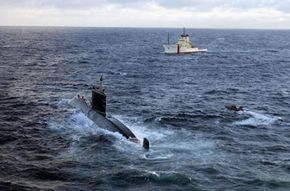
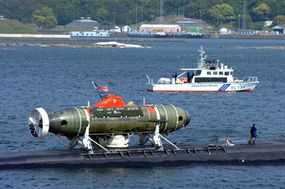
Stricken Canadian submarine HMCS Chicoutimi wallows in heavy seas as a salvage vessel moves into position.
Getty Images
A submarine explodes 3,000 feet beneath the ocean's surface, sealing off the crew in a confined space. It's cold and dark, and oxygen supplies are running low. Pressure keeps the hatch closed, but even if it opened, the human body could never survive at this depth. The only thing to do is to wait for help from above.
Fortunately this scenario isn't one that happens very frequently. Deep-sea rescue missions are few and far between because of the rarity of submarine disasters. Only a handful of countries even maintain deep-sea rescue operation capabilities. As a result, most missions are carried out on a multinational basis.
Advertisement
In this article, we'll look at the history of deep-sea rescue and the special equipment currently being used and in development. We'll also look at some of the training exercises, as well as efforts being made around the world to avoid submarine disasters.
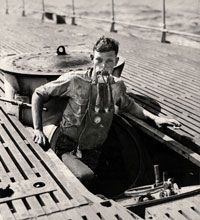
USS V-5 (SC 1) crewman A. L. Rosenkotter exits the submarine's escape hatch wearing the "Momsen Lung" emergency escape breathing device during sea trials.
Photo courtesy U.S. Navy
In 1939, the U.S. Navy submarine Squalus sank during a test dive in 250 feet of water off the coast of New England. At the time, the Squalus was the most advanced sub in the Navy's fleet. There was a general feeling in those days that a submarine sinking meant that the crew would perish -- there were no established rescue methods or rescue equipment. Navy submarine expert Charles "Swede" Momsen had the brilliant idea to use a diving bell to carry rescue sailors down to the sub.
A diving bell has a heavy platform attached to a bell-shaped cover. The bell is stabilized so it doesn't tilt, creating an airtight pocket of oxygen. Once the bell reached the sub, rescuers attached cables to the sub so they could tow it to the surface. Over the course of 39 hours and four trips, Momsen and his team were able to save the lives of all 33 crew members. For his efforts, he was awarded a commendation from President Franklin D. Roosevelt. Momsen also invented the "Momsen Lung," a rubber breathing bag worn around the neck that recycles exhaled air. Soda lime in the bag removes carbon dioxide and replaces it with breathable oxygen. The bag also allowed a slow and safe ascent to the surface.
Advertisement
Following the sinking of two U.S. nuclear submarines, the Thresher and the Scorpion, in 1963 and 1968, the Navy decided it was time to ramp up its research into deep-sea rescue efforts. All personnel aboard these two subs perished, and the incidents rocked the Navy. In 1964, the Navy's Ocean Engineering Program started the Deep Submergence Systems Project (DSSP) to develop deep-sea rescue vehicles (DSRV) that could descend and attach to sunken submarines to deliver the sailors to safety.
One of the objectives of the DSSP was to deploy and reach any submarine disaster area within 24 hours of notification. The Navy partnered with the Lockheed Corporation to help develop these rescue vehicles. The tricky part in the construction phase was making them sturdy enough to withstand deep-sea water pressure, while being light enough for transport by airplanes, ships or trucks. The first two DSRVs were in the water by 1970 for testing. After successful rescue exercises were completed, the DSRVs were delivered to the Navy and put into service in 1971. The Navy dubbed the two rescue vehicles Mystic and Avalon.
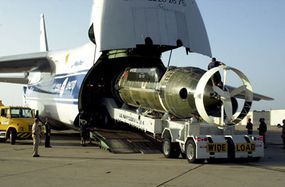
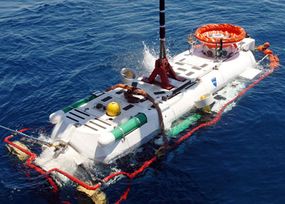
The DSRV-1 Mystic being checked off the coast of southern California.
Photo courtesy U.S. Navy
The Mystic and Avalon are nearly 50 feet long and weigh close to 50 tons each. They have a maximum depth capability of 5,000 feet and are equipped with Doppler radar and three types of sonar. Six different video cameras and one 35-mm still camera send visual information to the surface. The DSRVs require a four-man crew, two pilots and two rescue personnel, and can carry a maximum of 24 passengers [source: U.S. Navy]. The Avalon has an inactive status now because of its age, but the Mystic remains at the ready for deployment anywhere in the world.
In the next section, we'll explore some of the equipment used in deep-sea rescue efforts.
The Priz Rescue
In August 2005, the Russian submarine Priz became snared in underwater cables on the bottom of the ocean off the coast of Siberia. The sub was trapped, and the seven Russian sailors aboard the Priz faced certain death with their oxygen supplies running out and temperatures reaching lows of 43 degrees Fahrenheit (6 degrees Celsius). After a failed rescue attempt by a Russian Navy team, a distress call was sent out and the British Royal Navy was the first to respond.
Initially, it was thought that the minisub was caught in fishing nets. It was later found that the web of cable was part of an underwater surveillance antennae anchored to the sea floor. Using the unmanned Scorpio rescue sub, the cables were cut loose, freeing the sub after 72 hours on the ocean's floor. Military doctors were on hand to treat the men, all of which were in fairly good shape considering the peril they faced [source: BBC].
Advertisement
Deep-sea Rescue Equipment
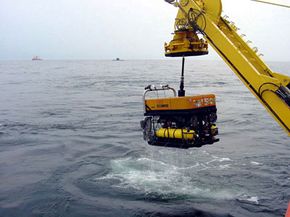
Remote Operated Vehicle Super Scorpio is retrieved after completing a pod delivery exercise during Sorbet Royal 2002.
Photo courtesy U.S. Navy
The equipment used in deep-sea rescues is like something from a James Bond movie. From remote-controlled subs with robot arms to deep-sea diving suits, modern technology has greatly increased the odds of a successful rescue.
Remote-operated vehicles (ROVs) are a crucial part of deep-sea rescue. These underwater craft range in size from 2 feet long to the size of a small car. They're typically tethered to another submarine or surface ship. The power and remote capabilities are supplied by this tether, which also provides a conduit for the video and audio relay cables. ROVs are usually equipped with both video and still cameras. They also have remote-operated robotic arms with lifters, grabbers, pinchers and cutters. Many times an ROV is sent down to access the situation so the crew can decide the best course of action for response. If the disabled submarine is simply trapped or has lost power, the ROV can often cut it free or tow it to the surface.
Advertisement
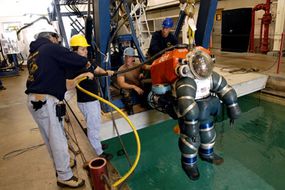
Hard-shelled suits that can withstand pressure as deep as 2,000 feet, known as Atmospheric Diving Suits (ADS), were put into action in 2001. With a constant internal pressure of one atmosphere, the ADS allows divers to ascend to the surface at any rate of speed without requiring decompression. With this technology, human divers are now able to access situations firsthand, provide emergency life support and prepare the sub for mating, the process of joining the vessel to another.
Submarine Rescue Chambers (SRCs) are metal pods that can be attached, or mated, to a disabled submarine. These chambers remain pressurized and allow for the safe extraction of the crew. Once on board, the SRC detaches from the sub and ascends to the surface at a safe rate. There's a similar unit called a Transportable Recompression Chamber System (TRCS) that's used in the evacuation and recompression of deep-sea crew. A transfer lock attaches and forms an airtight seal between the sub's hatch and the TRC, allowing medical personnel to go back and forth in a pressurized environment. Like the SRC, the TRCS is pulled back to the surface by a cable and the crew is gradually recompressed.
The Atmospheric Dive Suit (ADS) is lowered into the water for a dive.
Photo courtesy U.S. Navy
Another new addition to the deep-sea rescue fleet is the Emergency Evacuation Hyperbaric Stretcher (EEHS), portable, collapsible one-man chambers that are used to move individual sailors to safety in a pressurized environment. The EEHS was used in the extraction of the trapped miners in Somerset, Pa., in 2002. The air pressure that miners experience deep into the earth is similar to the water pressure that deep-sea divers endure. The EEHS provides safe transport to recompression chambers.
In the next section, you can find out about deep-sea rescue training exercises.
Baby's Got the Bends
Decompression sickness, also known as "the bends," is a symptom that many SCUBA divers and submariners face when they ascend to the surface too rapidly. As you dive, pressure on your body increases, causing more nitrogen and oxygen to dissolve in your blood. Most of the oxygen is consumed by tissue, but not the nitrogen. The dissolved nitrogen is what causes the bends.
If you ascend too quickly, the nitrogen leaves your blood too fast and forms bubbles. These bubbles block tiny blood vessels. This can lead to strokes, heart attacks, ruptured blood vessels in the lungs and joint pain. Divers avoid the bends by following the recommended ascension rate. You can learn more about the bends in What if my scuba diving equipment failed?
Advertisement
Deep-sea Rescue Training
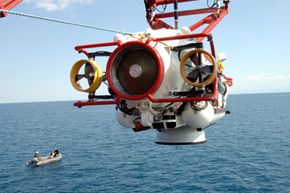
U.S. Navy divers in a rigid-hull inflatable boat assigned to Mobile Diving and Salvage Unit Two (MDSU2) watch the United Kingdom's submarine rescue vehicle LR-5 after hooking it up to a crane.
Photo courtesy U.S. Navy
Sorbet Royal may sound like a French dessert, but it's actually the most intensive deep-sea rescue training exercise in the world. The NATO-sponsored event is held every three years, alternating between locations in the Baltic and Mediterranean Seas. Sorbet Royal 2005 floated its way into Taranto, Italy, for 11 days of multinational rescue exercises with participants from 24 nations, including, for the first time, divers and submariners from the Ukraine and Russia. The goal of each Sorbet Royal is to top the previous one in the intensity and scope of the exercises.
Italy, the Netherlands, Spain and Turkey supplied the subs to be used for the exercises -- each one taking turns being sunk several hundred feet to the bottom of the ocean with crew members aboard. The complexity of the rescue scenarios was intensified at the 2005 Sorbet by staging rescues of multiple vessels instead of one at a time. The different countries responded together, sharing techniques and learning the compatibility of the equipment they use. Submarines travel great distances from their home bases, and the ability of other countries to respond to a distress call is crucial to the successful rescue of the crew. The submarine community is tight-knit and crosses international boundaries.
Advertisement
The 2005 Sorbet was an important one. There have only been 170 deep-sea accidents in the 120-year history of the submarine, but eight have been in the last 10 years. This includes the 2005 loss of the Russian nuclear sub, Kursk. In that accident, the sub was disabled 350 feet down, with 118 crew members aboard [source: Guardian]. The British Navy responded to the alert but was unable to save anyone. The loss of the Kursk was a strong motivator for the Russians to participate in the 2005 exercise.
On the first day of exercises the multinational teams got their feet wet by performing the following drills:
RESCUEX - the rescue of crew members from a submarine
SURVEYEX - the survey of a disabled submarine by divers
MATEX - attaching and freeing a rescue chamber to submarine
The United Kingdom's submarine rescue vehicle LR-5 is lowered into the water by a crane from the Finnish ship Fennica during Sorbet Royal 2005.
Photo courtesy U.S. Navy
The teams tested the latest equipment, some of it for the first time. Atmospheric diving suits and hyperbaric stretchers both played key roles in the training. The final exercise of the event was a 36-hour rescue of 80 simulated casualties at a depth of 236 feet. The teams used techniques from each of the previous exercises in the well organized rescue effort. Medical specialists on the surface acted out the techniques for treating the casualties for a variety of illnesses and injuries.
This is where deep-sea rescue is today. In the next section, we'll take a look at where it's headed.
Advertisement
The Future of Deep-sea Rescue
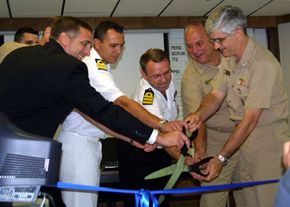
Admiral Kirkland H. Donald, right, and members of the International Submarine Escape and Rescue Liaison Office cut the ribbon at the opening of the new ISMERLO Coordination Center, located in Norfolk, Va.
Photo courtesy U.S. Navy
Continuing efforts are being made to keep the international submarine community one step ahead of the curve in deep-sea rescue efforts. One key element to this was the opening of the International Submarine Escape and Rescue Liaison Office (ISMERLO) in June 2005. The ISMERLO team, whose office is located in Norfolk, Va., is made up of deep-sea escape and rescue experts from around the world. The goal of ISMERLO is basically to be a 9-1-1 station for all submarine rescue attempts, acting as a go-between for the different submarine communities around the globe. It also endorses procedures and helps to establish international standards for response and rescue. ISMERLO was first used in the training exercises at the 2005 Sorbet Royal, and this experience was crucial to their success of the Priz rescue effort.
In addition to sponsoring the Sorbet Royal, NATO has also begun work on a project called the NATO Submarine Rescue System (NSRS), a European rescue system involving the help of France, Norway and the United Kingdom. The goal of the NSRS is to develop faster response times and the ability to extract and treat more crew members at once.
Advertisement
The actual rescue system is made up of the following elements:
Rescue vehicles, both manned and remote-operated
Portable launch and recovery system
Decompression units
Emergency life-support capabilities
Communications equipment
The fast attack submarine, USS La Jolla, with the Deep Submergence Rescue Vehicle Mystic attached.
Photo courtesy U.S. Navy
To maximize each rescue effort, the NSRS rescue unit is capable of holding up to 72 crew members at one time, more than double the amount of the United States' DSRV. The equipment is strong enough to withstand the pressures of the deep but light enough to be transported by plane to anywhere in the world within a 72-hour time frame. The three-man crew can take the unit as deep as 2,000 feet with full operational capabilities. It's currently housed at a naval base in Scotland, near several military and civilian airports.
For more information on military and civilian rescue, please move ahead to the links on the following page.
Undersea Salvage
Deep-sea exploration doesn't always involve rescue. From the wreckage of the Titanic to the search for sunken treasure, there's a great deal of civilian interest in what lies beneath the surface. In 1999, Discovery Channel sponsored a deep-sea recovery effort to raise the Liberty Bell 7 space capsule from the ocean's floor.
Gus Grissom was the second man ever launched into space, taking a suborbital flight in the bell-shaped capsule in 1961. The splashdown on his return nearly killed him, but he was able to find rescue from naval helicopters while his spacecraft sunk 15,000 feet to the bottom of the ocean. Fast-forward 38 years later, when Discovery Channel's civilian underwater salvage team was able to bring the capsule to the surface and send it to its home, on display in the Cosmosphere Museum in Kansas [source: CNN].
"Deepwater rescue system ready to surface." businessweekly.com, May 30, 2007. http://www.businessweekly.co.uk/2007053030939/high-tech-archive/deepwater-rescue-system-ready-to-surface.html
"Defence Projects: NATO Submarine Rescue System (NSRS)." armedforces.co.uk, 2008. http://www.armedforces.co.uk/projects/raq3f6dac45ad605
"Drama documentary captures emotional meeting of Russian submariners and their British saviours." BBC, January 4, 2006. http://www.bbc.co.uk/pressoffice/pressreleases/stories/2006/01_january/04/sub.shtml
"Liberty Bell 7 capsule raised from ocean floor." cnn.com, July 20, 1999. http://www.cnn.com/TECH/space/9907/20/grissom.capsule.01/
"Russians saved in deep-sea rescue." BBC, August 7, 2005. http://news.bbc.co.uk/2/hi/europe/4128614.stm
"Sorbet Royal '05." sorbetroyal.celex.net, 2008. http://sorbetroyal2005.celex.net/
"Submarine plan breaks the surface." bbc.com, April 24, 2007. http://news.bbc.co.uk/2/hi/uk_news/scotland/north_east/6587443.stm
"Submarine Rescue Diving and Recompression System (SRDRS)." globalsecurity.org, 2008. http://www.globalsecurity.org/military/systems/ship/systems/srdrs-history.htm
"Submarine Rescue: Ready for the Unthnkable." navy.mil, 2008. http://www.navy.mil/navydata/cno/n87/usw/issue_9/sub_rescue.html
Piggot, Mark O. "ISMERLO Put into Action for Submarine Rescue Exercise." navy.mil, June 15, 2005. http://www.navy.mil/search/display.asp?story_id=18783
Seenan, Gerard. "Deep-sea rescue team tells of drama and relief." guardian.com, August 10, 2005. http://www.guardian.co.uk/uk/2005/aug/10/military.russia.
Shewman, McClain. "Allies surface from Deep Sea Rescue Exercise." navy.mil, 2008. http://www.csp.navy.mil/news/dsrv.htm
Zask, Andrew. "New International Submarine Rescue Coordination Center Opens." navy.mil, September 29, 2004. http://www.navy.mil/search/display.asp?story_id=15339
Cite This!
Please copy/paste the following text to properly cite this HowStuffWorks.com article: