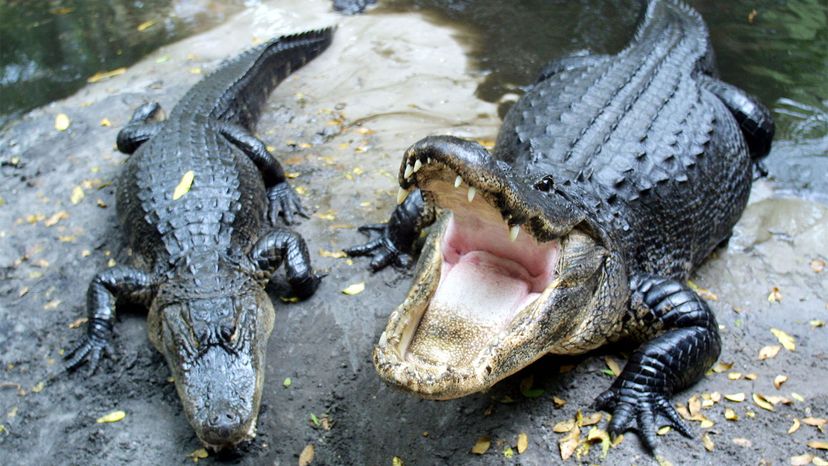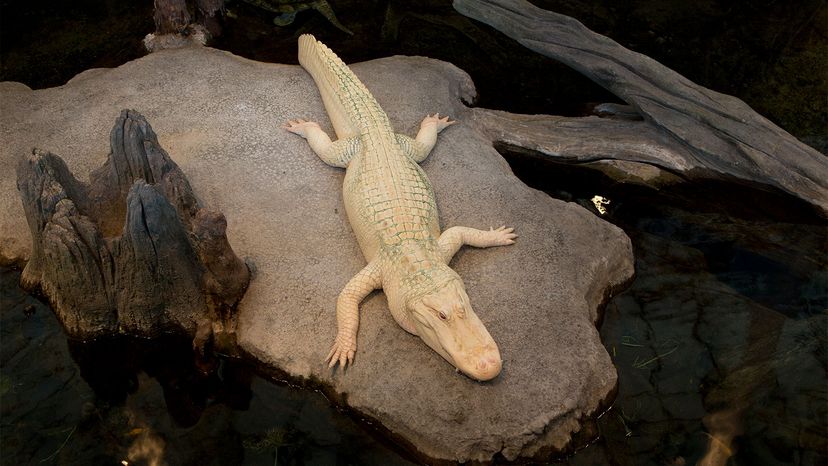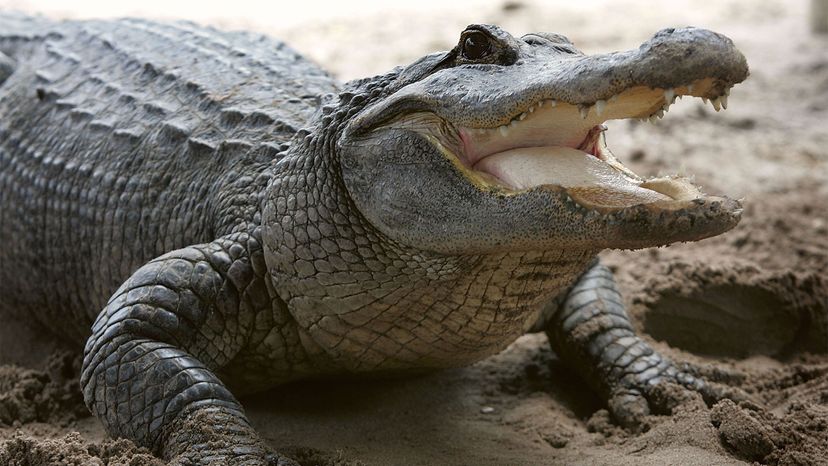
Much like the cheetah, the alligator is an incredibly fast runner. Perhaps you've seen one rise up on its long, muscular legs and sprint 500 yards (457 meters) across a wide-open field after fleeing prey.
No? You've never witnessed such a thing? What you've probably witnessed is something like this: You're standing by a lagoon, checking out a pelican, when you notice two small bumps that protrude from the water. After you take note of the "Don't Feed the Alligators" sign, you put two and two together and decide those bumps are the eyes of said creature lazily floating in the lagoon. You're frightened for a moment, but then you remember the classic adage: You can escape an alligator if you run in a zigzag. And this brings you comfort.
Advertisement
But should it? This saying, which is so old and so widespread that it's virtually impossible to determine where or why it was ever started, implies a couple of things: One, it implies that an alligator is likely to chase you a long distance on land. Two, it implies that alligators can run faster than humans — at least when they're running in a straight line.
The truth is, although alligators are frighteningly quick, they're not cheetah fast and they don't like to run long distances. It's very rare for an alligator to chase a human on dry land. And the average human could easily outrun an alligator, zigzagging or not — it tops out at a speed of around 9.5 miles per hour (15 kph), and it can't maintain that speed for very long [source: University of Florida].
More importantly, gaining on prey via a long sprint is not the alligator's attack tactic. The alligator prefers to sneak up on its prey in the water. It's a much faster swimmer than runner — it can swim 10 miles per hour (16 kilometers per hour) [source: University of Florida]. And it's silent as it moves through water. Its eyes are set on top of its head, so it can swim while watching what's happening on the surface. It can also remain underwater for extended periods of time and hold its breath for up to one hour.
So sure, you could probably escape an alligator if you ran in a zigzag. You probably also could escape one if you ran in a straight line. But the likelihood that an alligator would ever chase you on dry land is so low that the old adage is more joke than genuine advice. It simply doesn't apply.
Why wouldn't an alligator chase you? And how would it attack you instead?
Advertisement